
Fuel Tank Capacity on Semi Trucks: Why Winter Idle Time Shrinks the Range You Planned
A semi truck’s fuel tank capacity is a fixed number on the spec sheet: twin 120-gallon tanks, a single 150-gallon tank, whatever the build calls for. It rarely changes. What changes is how much of that fuel reaches the wheels. An engine idling to keep the cab warm, hold air pressure, or protect a cold-sensitive load burns fuel that was never budgeted for the road, and the range you calculated comes up shorter than the number on the tank suggests.
For owner-operators, fleet managers, and logistics teams running in cold-weather regions, the gap between paper range and real range decides when you fuel and how tight you can cut a dispatch window. Understanding how idle time interacts with fuel tank capacity on a semi truck keeps the schedule honest, and it keeps you off the shoulder of a frozen highway.
How Fuel Tank Capacity on Semi Trucks Is Measured and Configured
Owner-operators and fleet managers check fuel tank capacity early, because it sets how far a rig runs between stops. On a Class 8 tractor, the same number can mean different things depending on how the tanks are built, mounted, and filled.
Typical Diesel Tank Size in Gallons
Most highway semi trucks carry 100 to 300 gallons of diesel in one or two tanks. Day cabs and shorter regional routes often run a single tank; long-haul trucks that need range run duals.
| Configuration | Typical Capacity | Common Use |
|---|---|---|
| Single tank | 50-150 gal | Day cab, regional |
| Dual tanks (each) | 60-150 gal | Long-haul |
| Dual total | 120-300 gal | Over-the-road |
| Aftermarket large | 150-300 gal each | Extended range |
Single vs. Dual Tank Setups
Dual tanks are linked by a crossover or equalizer line, so both sides draw down together and the engine pulls fuel evenly. That keeps weight balanced and lets a driver fill from either side. A single tank saves weight and cost but caps the miles before a refill.
Usable Fuel vs. Nominal Capacity
Rated capacity is not usable fuel. A tank labeled 120 gallons might deliver only 100 to 110 gallons before the pickup tube starts drawing air. Manufacturers leave headspace for thermal expansion and a few inches at the bottom so sediment and water never reach the fuel system. That is why a 240-gallon truck may realistically burn closer to 200 gallons between fills. For a deeper look at how these figures are calculated, review our guide to fuel tank capacity on semi trucks.
How Tank Geometry Affects Total Onboard Volume
OEM tanks are usually cylindrical or rectangular and sized to fit the frame rails. Aftermarket builders reshape them – longer, taller, or stepped – to fit more fuel on the same chassis. Baffles and stepped designs help, but geometry still limits how much fits before you exceed weight limits. To compare this with bulk haulers, see our guide to how many gallons a commercial tanker truck can hold.
Onboard Fuel System: How Fuel Moves During Idle
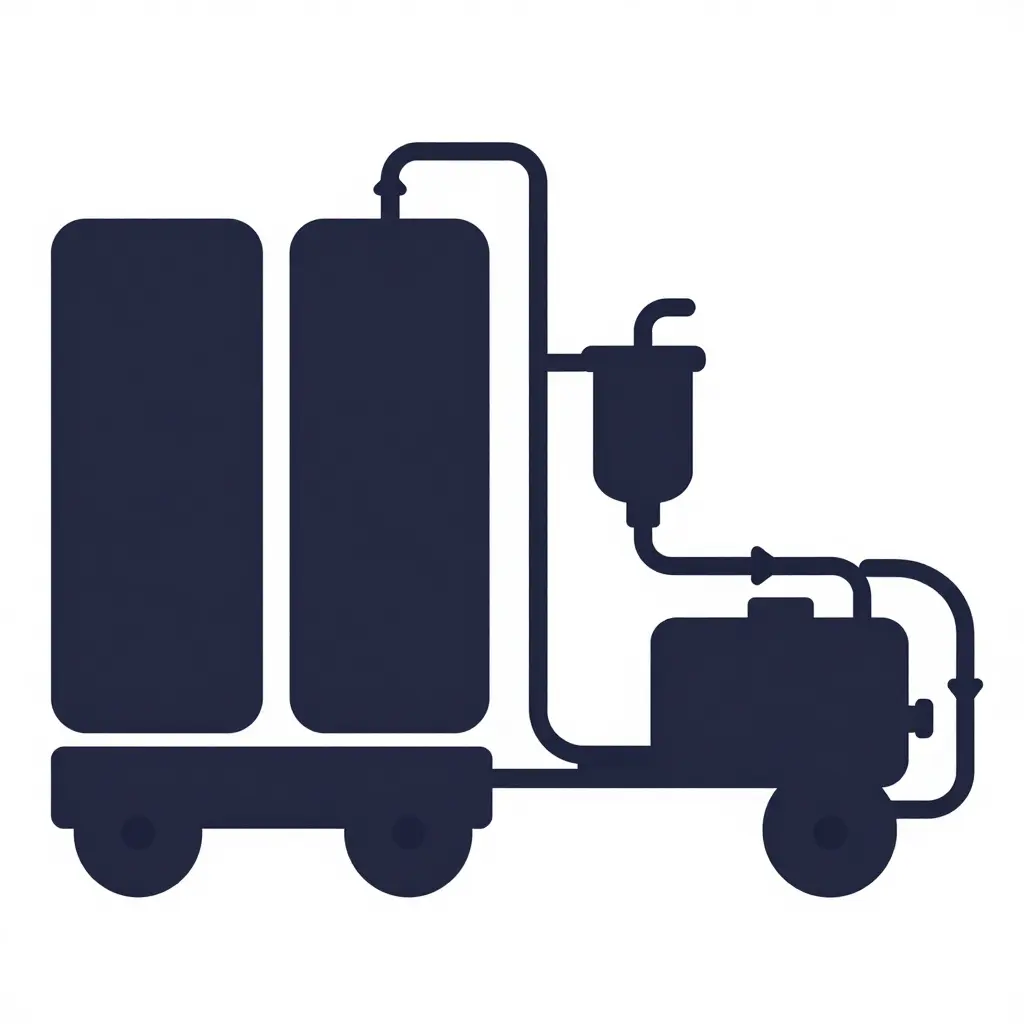
To see why idle time costs range, it helps to know the path fuel takes through the truck. The diagram below shows the onboard fuel circuit: tanks, supply lines, primary filter, engine, and return line.
Following the Flow
While a truck sits idle with the engine running, the circuit works like this:
- Fuel tanks hold the diesel supply. On most Class 8 tractors, this means one or two saddle-mounted tanks straddling the frame rails.
- Supply lines draw fuel from the tanks and carry it forward. A low-pressure lift pump moves fuel toward the engine.
- Primary filter (often a water-separator unit) strains out contaminants and separates moisture before fuel reaches the sensitive high-pressure components.
- Engine receives the filtered fuel. During idle, only a small fraction is actually burned to keep the engine turning over.
- Return line carries the surplus, warmed fuel back to the tanks. The loop runs constantly.
Why the Return Line Matters in Winter
The important part of the schematic is the return line. Fuel does not flow one way; a large share of what leaves the tank comes back, and it comes back warm. During idle, that circulation is what keeps fuel above its cloud point in freezing conditions.
The engine burns very little fuel per hour but recirculates a high volume, so the tank drains slowly while the fuel keeps warming. That is why idle burn is so sensitive to temperature, and why the range you budgeted for shrinks.
To explore how tank size and usable volume factor into those calculations, see our guide to fuel tank capacity on semi trucks.
How Winter Idle Time Drains the Fuel You Planned to Burn Driving
When the temperature falls, a truck becomes a shelter before it becomes a vehicle. The engine runs long before the wheels roll, and every minute of idle in the cold burns fuel that will not move the load. Winter idle time is one of the most common reasons a calculated range comes up short.
Diesel engines idle in cold weather for real reasons. Cab heat keeps a driver warm and alert during rest periods, and it is not optional when the night drops below freezing. A cold block is also hard to start: the oil thickens and bearings and seals take the stress on the next turn of the key. Emissions hardware adds its own demands. Diesel exhaust fluid (DEF) lines and tanks are heated so the fluid keeps flowing, and the air brake system relies on the engine-driven compressor and heated air dryers to purge moisture that would otherwise freeze and make the brakes unreliable.
Diesel idle consumption does not stay constant. It climbs as the temperature drops. A turbo-diesel working to hold cab temperature, keep the block warm, and manage DEF and air systems burns more fuel per hour in the cold than on a mild day.
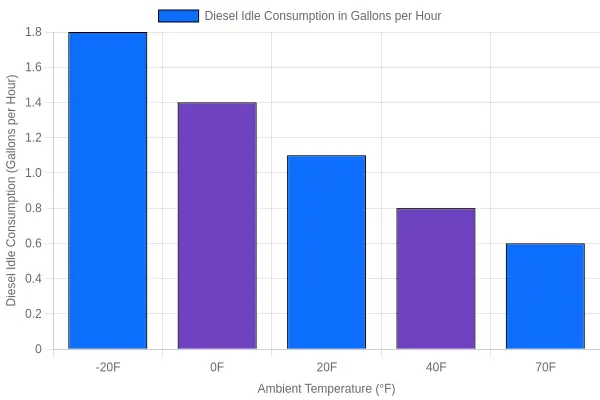
A driver who idles for a ten-hour rest at 0°F might burn close to 14 gallons before moving an inch. The same stop at 70°F uses roughly 6 gallons. Across a fleet and a long winter, cold weather fuel efficiency erodes from the top of the tank down.
Idle fuel comes out of the same fuel tank capacity you counted on for the load. There is no separate reserve; the tank is one budget. Every gallon pulled to warm the cab shortens the distance between fuel stops and eats the margin you were holding for headwinds and hills. Planning winter routes around the fuel idle time actually consumes, rather than the fuel you wish it would, is covered in more detail in fuel tank capacity and its role in essential business operations.
How Winter Idle Time Eats Into Your Usable Range
The table below shows diesel idle consumption rising as ambient temperature drops. An overnight stop in deep winter can burn more than triple the fuel of a mild-weather stop, and every idle gallon comes out of the same tank you rely on for driving. See our guide to fuel tank capacity on semi trucks.
| Ambient Temperature | Approximate Diesel Idle Consumption (gal/hr) | Typical Idle Hours per Overnight Stop | Estimated Gallons Consumed per Stop |
|---|---|---|---|
| 40F (4C) | 0.8 | 8 | ~6.4 |
| 20F (-7C) | 1.0 | 10 | ~10.0 |
| 0F (-18C) | 1.3 | 12 | ~15.6 |
| -20F (-29C) | 1.6 | 14 | ~22.4 |
Note: These are indicative figures for illustration only. Actual diesel idle consumption and overnight idle hours vary widely by engine make and size, idle-control strategy, cab and sleeper insulation, APU or bunk-heater use, and wind exposure. Always use your own real-world data when planning fuel stops.
What Actually Drives Winter Idle Fuel Consumption
Cold mornings change the math on every truck, but how much depends on the equipment and the habits. No two tractors burn the same fuel while parked. The biggest factors are:
- Engine displacement: Bigger, higher-horsepower diesels move more fuel per revolution, so they idle thirstier than smaller powerplants.
- Idle RPM: Elevated warm-up idle speeds, programmed to build heat faster, burn noticeably more than a low factory idle.
- Cab and bunk heater use: Running the sleeper heater all night keeps the driver comfortable but adds a steady draw that can rival the engine’s own consumption.
- Battery and auxiliary loads: Inverters, APUs, refrigerators, and chargers pull current, and a weak battery forces the alternator to work harder, raising the burn.
- Fuel gelling and winterized blends: Cold-soaked diesel gels, and the #1 or blended winter fuel that prevents it carries less energy per gallon, so you burn more for the same heat.
- Driver behavior: Idle duration, auto-start settings, and how often the heater cycles all swing daily consumption by several gallons.
Together these factors change the plan before the wheels turn. Winter idle time takes gallons out of the tank, and winterized blends deliver fewer BTUs per gallon, so the driving range from a given fuel tank capacity can fall by double digits in deep cold. Planning fuel stops, loads, and schedules around winter numbers instead of summer numbers is the point.
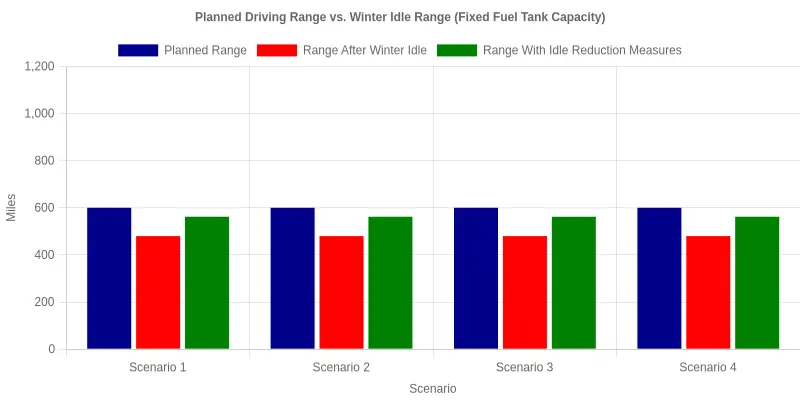
Caption: At a fixed fuel tank capacity, winter idle time cuts planned range from roughly 600 miles down to about 480 miles, a 120-mile shortfall that idle reduction measures recover to only around 562 miles.
Range Planning and Recalculating Fuel Stops When Winter Idle Time Is in Play
The range you calculate in July is not the range you can trust in January. Good fuel planning starts there.
Step 1: Turn Fuel Tank Capacity Into Real Miles
Fuel tank capacity becomes a driving range only when you attach an honest burn rate: usable gallons times real-world MPG.
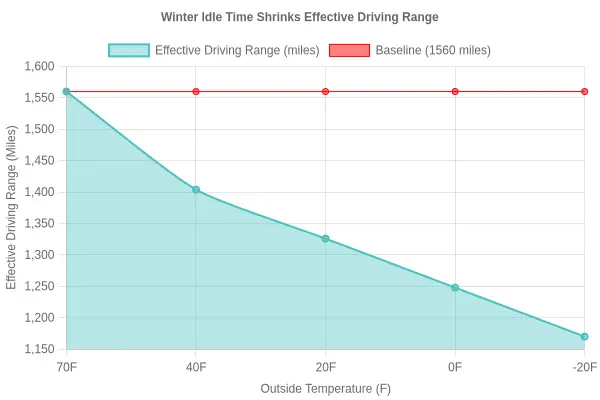
A 240-gallon truck at 6.5 MPG shows a paper range near 1,560 miles. That assumes every gallon moves the truck and none is spent standing still.
Step 2: Apply a Winter Adjustment Factor
Cold weather adds work to the same tank: idling to keep the cab warm, longer warm-ups, and winterized fuel that carries fewer BTUs per gallon. A practical winter adjustment factor runs between 0.80 and 0.90 of the warm-weather range.
The chart below uses the 240-gallon example.
Step 3: Build a Reserve Fuel Margin
Never plan to arrive on fumes. Hold a reserve fuel margin of at least 30 to 50 miles beyond the intended stop, and raise it on remote northern corridors where the next station may be far away or out of diesel.
Step 4: Recalculate Fuel Stop Intervals
Put the numbers together:
Usable gallons x winter MPG x adjustment factor – reserve = your true stop interval.
Using the 240-gallon truck at 0.80: 240 x 6.5 x 0.80 = 1,248 miles, minus a 40-mile reserve leaves roughly 1,208 usable miles between stops. On a 1,400-mile run, that means two fuel stops instead of one.
Recap
Convert fuel tank capacity to miles with a real MPG, apply a winter adjustment factor, protect a reserve margin, then recalculate stop intervals before you roll. For how tank size drives these numbers, see oil tanker truck capacity in the US.
Strategies to Protect Winter Range
Cold weather erodes range, but the loss is not inevitable. These measures cut idle time and stretch every gallon in the tank.
-
Install auxiliary cab heaters. A diesel-fired bunk heater warms the sleeper and windshield without idling the main engine, cutting the hours the truck burns fuel while parked. It is often the single most effective way to reclaim lost range.
-
Enable automatic engine shutdown and start-stop systems. Programmable shutdown timers and start-stop controls cut the engine after a set idle window and restart it only when needed.
-
Switch to optimized winterized fuel blends. Blended #1 and #2 diesel resists gelling at low temperatures and keeps the fuel system clean. The right blend protects performance and the usable volume of your tank.
-
Adopt a firm idling policy for fleets. Written limits on idle duration, enforced through telematics and driver coaching, save the most across a fleet. Consistency matters more than any single piece of equipment.
-
Use battery and block heaters. A block heater keeps coolant and oil warm for easier cold starts, and battery warmers preserve cranking power. Both reduce the long warm-up idles that burn fuel.
-
Plan refueling around your routes. Map fuel stops against the day’s terrain, grades, and forecast temperatures so you never gamble on range in a headwind or a deep freeze.
Fleets that want hardware built for these habits should work with fuel tank manufacturers who can match capacity and plumbing to the operating conditions.

The schematic splits a full tank into two budgets before the cold season starts. The top block is total capacity. The larger share is the driving budget, which becomes usable range; the smaller share is the idle budget, which becomes the idle reserve. Every gallon committed to idling comes off the distance you can haul.
Frequently Asked Questions: Winter Idle Time and Semi Truck Range
How much fuel does a semi truck burn while idling in winter?
A typical Class 8 semi truck burns about 0.5 to 1.0 gallons of diesel per hour at a standard idle; winter pushes that higher. Raising the idle speed to keep the engine, cab, and bunk warm can bring consumption to roughly 1.0 to 1.5 gallons per hour. An eight-hour rest can therefore cost 8 to 12 gallons before the truck turns a wheel.
Does winter idle time really reduce driving range?
Yes. Every gallon burned at idle never moves freight. If a truck burns 10 gallons idling overnight at 6.5 mpg, that is roughly 65 miles of range gone from the route you planned.
How much reserve fuel should I keep in cold weather?
Plan on keeping at least 25 to 30 percent of your usable capacity as a reserve in winter, compared with the 10 to 15 percent that is often enough in mild weather. Cold thickens diesel and gelling can restrict flow, while unexpected idling and reroutes shrink your margin fast. A larger buffer keeps you from stranding yourself far from a reliable fuel stop.
Do auxiliary heaters save fuel compared to engine idling?
Auxiliary heaters and APUs are far more efficient than idling the main engine. A diesel-fired heater or APU typically uses 0.1 to 0.3 gallons per hour to warm the cab and bunk, against about 1 gallon per hour for a cold-engine idle. Across a fleet and a full winter, that difference adds up to thousands of gallons.
How should fuel tank capacity factor into winter route planning?
Treat fuel tank capacity as a planning constraint, not a spec-sheet number. Winter idle time makes effective range smaller than the sticker figure. Map fuel stops from usable capacity minus idle consumption and a cold-weather reserve, and add margin on remote routes. For how tank sizing shapes daily operations, see fuel tank trucks in essential business operations.
Conclusion
Fuel tank capacity is fixed: a number stamped on the spec sheet. It describes potential, not guaranteed distance. Winter idle time takes usable fuel out of the tank, and the range you planned shrinks with every cold night spent idling at a truck stop or parking lot.
Idle consumption is real fuel leaving the tank at a predictable hourly rate that climbs in freezing conditions. Recalculate range before trusting the gauge: factor idle burn into the plan. Auxiliary heaters, APUs, and better stop planning recover much of the lost capacity without giving up driver comfort.
For operators in cold-weather regions: measure your winter idle consumption, recalculate range with that number, and invest in idle-reduction equipment. That is what makes the capacity you paid for deliver the distance you need.