
Septic Tank Truck Cost: How Tank Size and Vacuum Pump Type Split the Price
Two variables drive most of the price of a septic tank truck: tank size and vacuum pump type. Buyers who know how each one feeds into a quotation can compare units line by line instead of reacting to the total at the bottom of an invoice.
Tank size sets the volume of steel required, the welding and fabrication labor, and the load the chassis must carry. A larger tank uses more material, needs heavier reinforcement, and calls for a stronger truck frame, all of which raise the baseline price. Buyers who want to see how those material and fabrication choices turn into line items can read the full septic tank truck cost breakdown. Pump type drives the functional cost of the vehicle instead: a rotary vane, liquid ring, or rotary lobe pump changes the purchase price, the performance, the maintenance interval, and how long the truck stays in service.
Pump Type: The Other Half of the Price Equation
Tank size decides how much a truck holds; the pump decides how fast it fills and empties. The vacuum pump type often moves your real septic tank truck cost more than a modest change in tank size.
The Four Main Pump Types
Rotary vane pumps are common and inexpensive. They are compact and move a lot of air, but the vanes wear and have to be replaced on a schedule, so the low purchase price comes with steady upkeep.
Liquid ring pumps handle wet, dirty loads without complaint, but they use service water, weigh more, and cost the most upfront. Their running costs are low because they have few wearing parts.
Rotary lobe pumps flow the most air, tolerate harsh duty, and last for years. They carry the highest rebuild costs of the four; only liquid ring pumps cost more upfront.
Diaphragm pumps are the cheapest option. They are simple, can run dry, and need little maintenance, but their low flow rate limits them to smaller tanks and light jobs.
| Pump Type | Purchase Price | Flow Rate | Maintenance | Durability |
|---|---|---|---|---|
| Rotary Vane | Low | High | Frequent (vanes) | Medium |
| Liquid Ring | High | Medium-High | Low | High |
| Rotary Lobe | Medium-High | Very High | Moderate | Very High |
| Diaphragm | Low | Low | Very Low | Low |
Buy the Cost Profile, Not the Sticker
A low purchase price can hide a large repair bill later. High flow usually costs more upfront and more at rebuild; a cheap pump often means frequent maintenance or a short service life.
The Ownership View
Operators who plan beyond the sale compare five-year ownership costs: purchase price, rebuild intervals, downtime, and fuel draw. Those numbers often point to a different pump than the price tag does.
A diaphragm pump may save thousands upfront, then give the savings back through limited throughput and early replacement. A rotary lobe pump is expensive to buy and rebuild but rewards heavy-duty fleets with fewer failures and stronger resale value. Liquid ring sits between the two.
A cheap pump on a large tank can cost more to run than a premium pump on a right-sized tank, so the two choices have to be made together. Vacuum pump type keeps affecting your septic tank truck cost long after the sale.
See the full breakdown of septic tank truck pricing
Vacuum Pump Cost vs. Capability: A Side-by-Side Comparison
The pump you bolt onto a septic tank truck can swing the build price as much as the tank. Weigh each type against cost before you commit capital:
| Vacuum Pump Type | Typical Price Range (USD) | Max Flow Rate | Typical Tank Size Match | Maintenance Frequency | Best-Fit Application |
|---|---|---|---|---|---|
| Rotary Vane | $800-$2,500 | 35-60 CFM | 500-1,500 gal | Moderate (every 500-1,000 hrs) | Small to mid-size tank trucks, general septic service |
| Liquid Ring | $3,000-$8,000 | 100-250 CFM | 2,000-4,500 gal | Low (every 2,000+ hrs) | Large industrial hauling, wet or vapor-heavy loads |
| Rotary Lobe | $2,000-$5,500 | 150-400 CFM | 2,500-5,000 gal | Moderate (every 1,000 hrs) | High-volume rapid transfer and denser sludge |
| Diaphragm | $500-$1,800 | 15-45 CFM | 300-1,000 gal | High (frequent valve and diaphragm checks) | Portable units, small tanks, chemical-resistant duty |
Caption: Below 1,000 gallons, a diaphragm or rotary vane pump gives the best value: low upfront cost matched to modest flow needs. Above 2,500 gallons, liquid ring and rotary lobe pumps earn their price through faster evacuation and less maintenance per gallon. Matching pump type to tank size, rather than buying the cheapest option, is what splits septic tank truck cost, as this guide to the full cost of a septic tank truck explains.
Several factors decide where a quotation lands:
- Tank capacity – Tanks from 2,000 to 5,000+ gallons demand more steel, more welding labor, and a heavier chassis, so each jump in size lifts the price quickly.
- Vacuum pump type – A basic rotary vane pump is affordable; a high-CFM liquid-ring or heavy-duty vane pump built for deep, fast suction costs noticeably more.
- Chassis class – A light cab-over suits small tanks, but a heavy-class tandem-axle chassis adds serious money plus the cost of a larger diesel engine.
- Tank material and gauge – Mild steel is the budget standard; thicker plate or stainless steel raises both durability and price.
- Baffling and reinforcement – Internal baffles and reinforced bulkheads limit sloshing and extend tank life, but they add manufacturing hours.
- Emission control systems – Newer EPA-compliant engines and DEF systems raise the chassis premium, especially on new units.
- Delivery or customization fees – Custom colors, hose reels, extra valves, and long-distance transport all show up as final line items.
Spending on capacity and pump quality usually pays back faster than cosmetic add-ons, so weigh each factor against your daily workload. For more detail, see our full septic tank truck cost breakdown.
How the Two Cost Drivers Converge
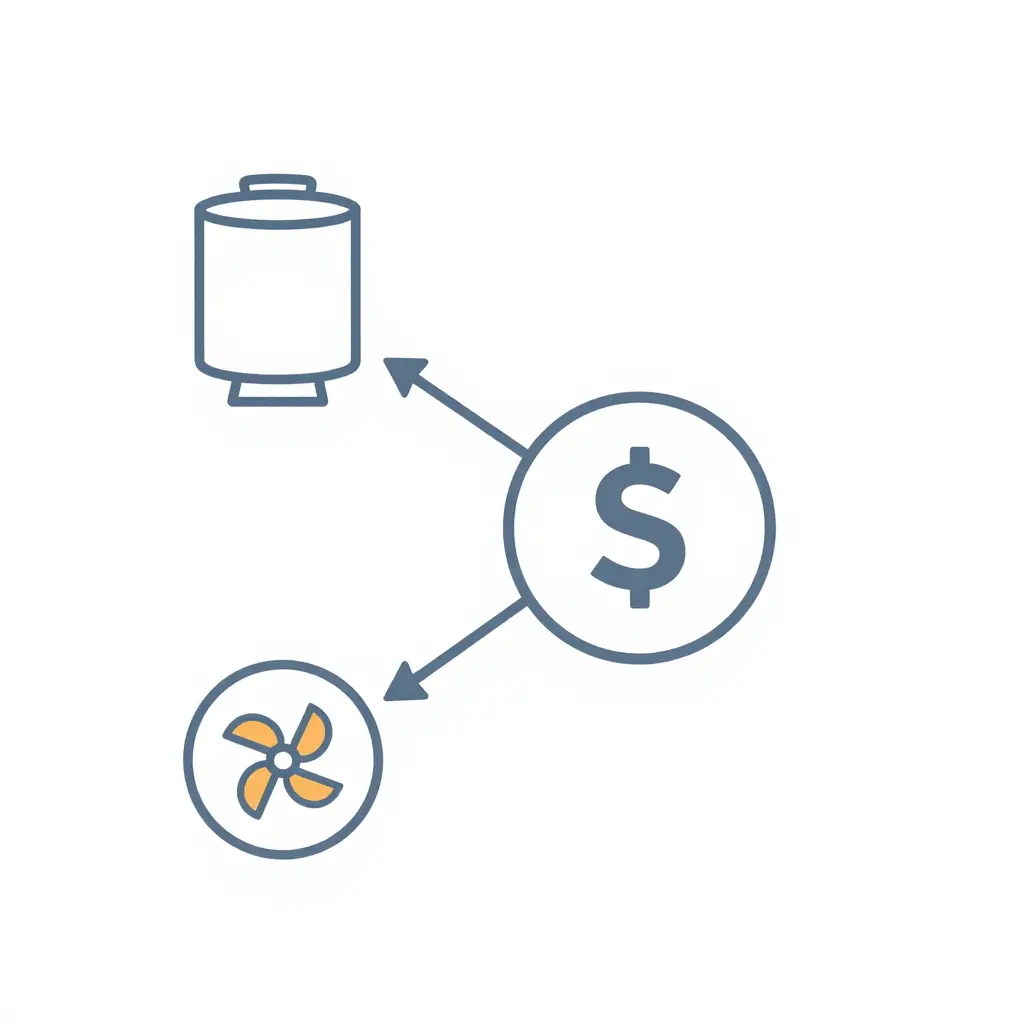
The schematic above shows how the two choices add up: total septic tank truck cost is the sum of two independent variables working together.
- The left input node (tank size) sets the raw capacity you are buying. A larger steel or fiberglass tank means more steel, more fabrication labor, and a heavier chassis to carry it, all of which push the base price up.
- The lower input node (vacuum pump type) sets the performance layer. A basic rotary vane pump costs far less than a high-capacity liquid-ring or high-vacuum blower system, so this choice alone can move the final invoice significantly.
The output node is what you pay. Because both inputs feed the same total, you cannot change one without touching the other. A premium pump on a small tank and a basic pump on a large tank can land at similar prices, which is why the combination matters more than any single spec.
Why the Split Matters for Your Budget
When you compare quotes, ask the seller to break the price into these two buckets. That tells you whether the extra money is going into capacity you will actually fill or into pumping technology that speeds up every job. For ready-built options, browsing low-price septic tank trucks for sale shows how real listings balance the two.
Treat the diagram as a checklist: whenever a spec sheet changes tank volume or pump model, read the output number again. That is the figure that shapes your fleet economics.
Where the Money Actually Goes: How Tank Size and Vacuum Pump Type Split the Price
On septic tank truck cost, the useful point is this: the total splits between two dominant variables, tank size and vacuum pump type, and the two choices pull the budget in opposite directions.
Start with proportions. In a typical new build, the tank and body take about 30% of the price and the chassis about 25%. The vacuum pump and its drive system take roughly 20%, emission and vacuum systems about 15%, and delivery or customization the final 10%.
| Component group | Share of total price | What drives the share |
|---|---|---|
| Tank and body | 30% | Steel volume, wall thickness, baffles |
| Chassis | 25% | GVWR, axles, engine |
| Vacuum pump and drive | 20% | Pump type, flow rate, PTO and gearbox |
| Emission and vacuum systems | 15% | EPA-compliant engine, DEF, vacuum plumbing |
| Delivery or customization | 10% | Hose reels, valves, paint, transport |
The ratio shifts as configurations change. Move to a 3,000-gallon tank and the added steel, baffles, and heavier chassis grow the tank-and-body and chassis shares, often pushing them past 60% combined. Switch from a standard pump to a high-CFM model and the pump-and-drive share climbs even when the tank stays the same, because faster evacuation demands a stronger drive line and heavier PTO.
The best configuration balances both. Match pump flow rate to tank capacity so you are not paying for volume you cannot fill or vacuum you cannot use. A mid-size tank paired with a well-matched pump delivers more usable gallons per dollar than an oversized rig at either end. Applying opportunity cost thinking to your tank choice keeps that balance in view.
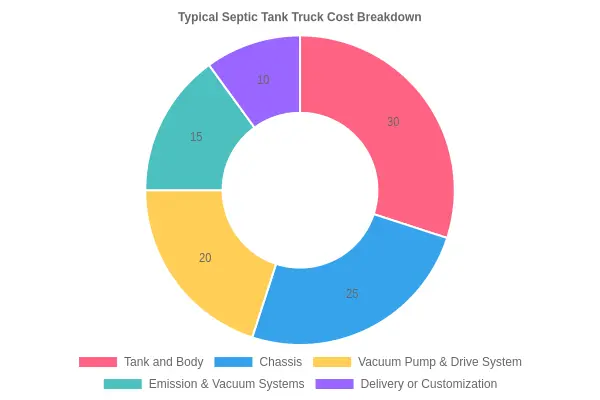
Caption: This doughnut is a baseline septic tank truck cost breakdown; the slices shift as you scale up. A larger tank widens the tank-and-body and chassis wedges, while a higher-tier vacuum pump expands the pump-and-drive segment and often the emission systems too. For real figures, see our breakdown of septic tank truck cost.
Budgeting and Procurement Guidance for a Septic Tank Truck
A septic tank truck is a capital purchase, so budget around the work it has to do rather than the sticker price. That keeps the total cost predictable over the life of the asset.
Set target capacity from your service routes
Before comparing quotes, work out the daily volume your routes have to move. A residential pumping route with short distances may need only a small tank, while industrial or municipal contracts often require a larger body and more frequent dumps. Count stops per day, average gallons per stop, and the round-trip distance to the disposal site. That math gives you the minimum tank size that avoids wasted trips and overtime.
Match the vacuum pump type to soil and sludge conditions
Capacity is only half of the spec sheet. The vacuum pump type decides how well the truck handles thick sludge, sandy soil, or long hose runs. Rotary vane and rotary lobe pumps suit heavy, high-solids loads; a diaphragm pump is usually enough for light residential work. The wrong pump means slow fills, worn parts, and frustrated crews. Looking at real configurations, such as these septic tank delivery trucks for sale, shows which pump and tank combinations fit your terrain.
Weigh total cost of ownership, not purchase price
A lower purchase price can hide higher running costs. Budget for fuel, tires, maintenance, pump rebuilds, insurance, and resale value. A truck that saves fuel and holds value often costs less per year than a cheaper unit. When you screen low-price septic tank trucks for sale, compare them on a five-year cost basis rather than the invoice.
A practical budget lists three numbers: acquisition, annual operating cost, and expected resale. If a route cannot cover all three, adjust capacity or pump type until it does.
FAQ: Septic Tank Truck Cost Questions Answered
How much does a septic tank truck cost overall?
A new septic tank truck usually costs between $90,000 and $200,000, depending on tank capacity, chassis, and pump configuration. Basic 2,000-gallon models sit near the lower end; specialized 5,000-gallon rigs with premium vacuum systems climb past $250,000. Used units often sell for $30,000 to $80,000. Reviewing septic tank delivery truck models helps buyers match specs to budgets.
How much does tank size add to the price?
Tank size generally adds about $8,000 to $15,000 for every extra 1,000 gallons of capacity. Moving from 2,000 to 3,000 gallons might raise the sticker by roughly $10,000; stepping up to 5,000 gallons pushes the total higher still, and chassis reinforcement and weight ratings grow along with the tank.
Does vacuum pump type change the price more than tank size?
Often, yes. The pump itself ranges from a few hundred dollars for a diaphragm unit to around $8,000 for a liquid ring, but the installed system is what moves the invoice: a premium pump with its drive, PTO, and controls can add $15,000 to $30,000 over a standard setup. Because the pump sets suction power, performance, and maintenance demands, its specs frequently outweigh an incremental step in tank capacity.
Which vacuum pump type offers the best value?
Rotary vane pumps offer the best value for most septic businesses, balancing cost, suction strength, and reliability. They handle routine septage work without the premium price tag of liquid-ring models. For continuous, heavy-duty industrial use, a liquid-ring pump pays off through longer service life and fewer breakdowns.
Do larger tanks always cost more per gallon?
No. Larger tanks often cost less per gallon because manufacturers spread fixed fabrication costs across more capacity. A 5,000-gallon tank may run around $18 per gallon, while a 2,000-gallon tank hits $25 per gallon. Chassis, weight limits, and pump requirements can reverse that economy at extreme sizes, though.