
A 2018 Chevy box truck is built on the Chevrolet Express Cutaway chassis, and the number that decides how long it can stay on the road is the size of its fuel tank. For the 2018 Chevy box truck, gas tank size most commonly comes to 33 gallons; the 31-gallon figure you see in some listings belongs to the standard Express van, not the cutaway. Either way, the fuel sits in one tank between the frame rails, so there is one fill point and one range figure for dispatch to work with.
Range is where tank size shows up in the schedule. At 10 to 12 mpg, a 33-gallon tank is worth roughly 280 to 355 working miles once a reserve is held back, and load weight, terrain, idling, and stop-and-go traffic all pull that number down. When a route runs past that window, a mid-shift refuel costs more than the twenty minutes at the pump: it resets the sequence, moves arrival times, and can push the last stops into the next day.
The sections below cover the tank sizes by configuration, the range math behind fuel tank capacity and route planning, and what a mid-shift refuel does to the rest of the day.
What Is the 2018 Chevy Box Truck Gas Tank Size?
Almost every 2018 box truck in this class is built on the Chevrolet Express Cutaway 3500 or 4500 chassis. Both leave the factory with a single midship tank mounted along the frame rail, and that capacity sets how the truck gets routed.
The standard cutaway tank holds 33 gallons. GM also offered a 55-gallon aft-axle tank on some builds, which is where the largest range figures come from. Diesel cutaways use their own tank and fuel-system part numbers, so a capacity should not be copied from a gasoline truck; for any specific vehicle, the 2018 Chevy box truck gas tank size on the door sticker or build sheet beats a marketplace headline.
When a fleet needed more time between stops, Chevrolet offered the 55-gallon option, and upfitters regularly added an auxiliary tank in the box or under the frame. Because the chassis is cut behind the cab, there is room for a second tank, and total capacity can run well past the factory figure.
| Configuration | Typical Capacity |
|---|---|
| Standard midship (gasoline) | 33 gal |
| Optional aft-axle tank | 55 gal |
| Upfitter auxiliary (box/underframe) | +30 to +60 gal |
| Diesel cutaway | Same 33/55 options; verify sticker |
The figure that counts is the one printed on the door sticker or build sheet. Used listings round, mislabel, or copy the wrong trim spec, so a 33-gallon truck is often advertised as 31. That gap changes the range estimate and the plan built on it, so check before routing the truck. Note any upfitter tank separately, and confirm both before the truck gets a route.
Why the Same Chevrolet Box Truck Shows Different Tank Sizes
Two 2018 cutaway box trucks can sit on the same lot with the same white paint and hold different amounts of fuel. The difference is not a defect or a clerical error; it comes from how each truck was specified and upfitted before it carried a pallet. For routing, the reason capacity varies matters more than any single number, because two trucks that look identical can run very different distances before the driver needs fuel.
The starting point is the chassis. A 3500 and a 4500 cutaway are built on different frames with different wheelbase and suspension options, and the tank has to fit that frame. Both series draw from the same factory tank options, so a 4500 ordered for heavy payloads does not automatically carry more fuel than a 3500 set up for local delivery. The baseline factory figures for the 2018 model show where each build starts.
Several choices change usable volume:
- Chassis and wheelbase: the tank is sized to the frame, and 3500 and 4500 builds use different tank part numbers.
- Single vs. dual rear wheel: the wider rear axle and suspension on a dual-wheel truck can change which tank fits.
- Gasoline vs. diesel: the two use different tank and fuel-system part numbers, so a diesel figure should not be assumed from a gasoline truck.
- Upfitter-added auxiliary tank: many box trucks gain a second tank during the body install to extend range.
- Aftermarket replacement tanks: high-mileage fleets often swap in a larger tank, which resets total capacity again.
These choices stack. A 3500 gasoline cutaway with a stock tank and a 4500 diesel dual-wheel build with an auxiliary tank can end up with very different range on the same route, even though the badges and the model year match.
So before a dispatcher assigns a route, confirm the tank on that specific truck instead of trusting a model-year figure from a listing. The volume you plan around decides how far the driver gets before refueling interrupts the day, and that one detail can shift an entire delivery schedule.
Fuel Tank & System Layout: Where the Tank Really Sits
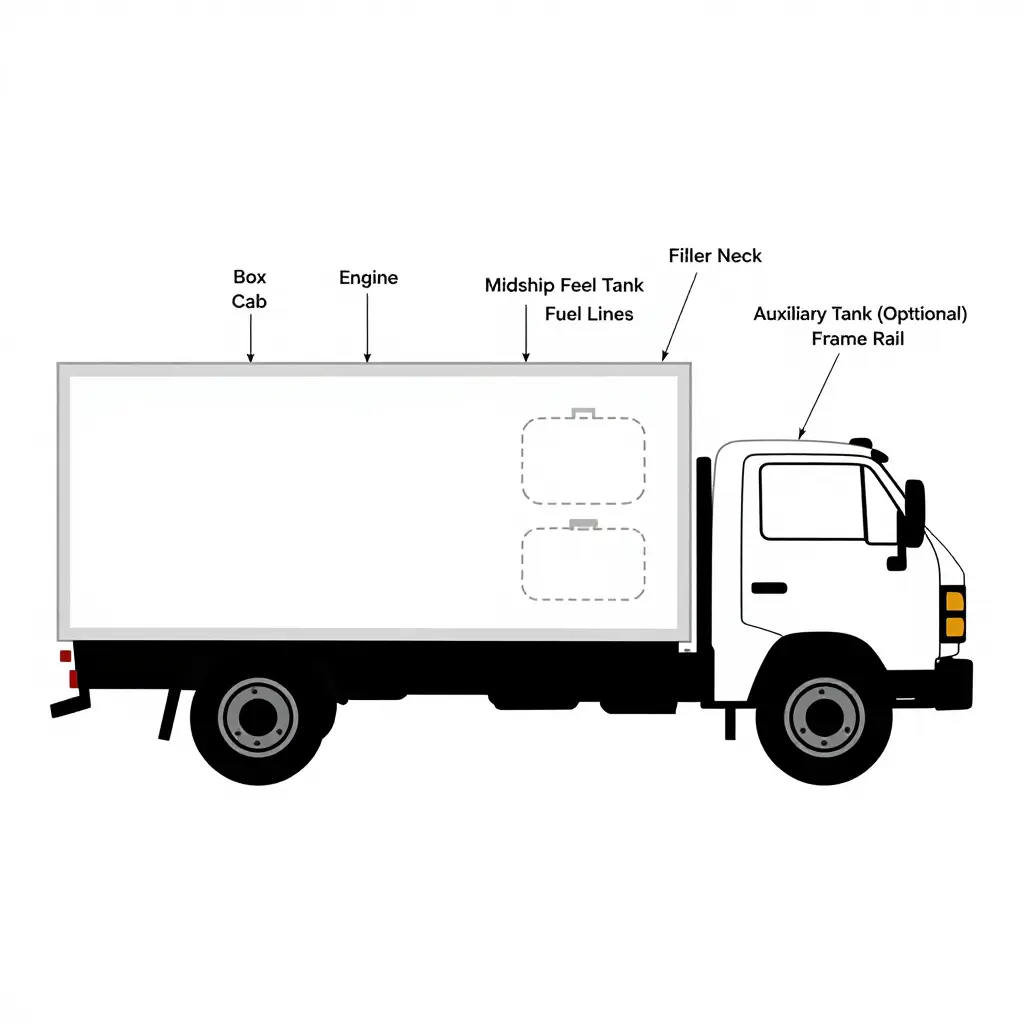
The schematic below lays out the fuel system on a 2018 cutaway chassis, from the cab and engine forward to the midship tank on the frame rail under the box body.
Reading the Diagram
- Cab & Engine (front): where the fuel is burned. Everything the tank holds has to reach this point.
- Midship Fuel Tank: mounted on the frame rail between the axles, the standard location on most cutaway box trucks. Its position balances weight and keeps it protected from side impacts.
- Filler Neck: the single point where you refuel. On a midship tank it usually sits just behind the cab door.
- Fuel Lines: feed lines running forward along the frame to the engine, with a return line routing back to the tank.
- Auxiliary Tank (Optional): shown in dashed outline in two possible spots, inside the box or under the frame. It is the most common way operators stretch range and cut down on mid-shift stops.
Use the layout to locate the filler neck and confirm how much usable capacity the midship tank gives you, then decide whether an auxiliary tank earns its weight on your routes. The full breakdown of the 2018 Chevy box truck gas tank size has the capacity figures that decision depends on.
Estimated Driving Range by Fuel Tank Configuration
Tank capacity says how much fuel a truck holds, not how far it goes. The number dispatch actually uses is usable range: the distance left after holding back a 10-15% reserve so the driver never runs dry on an unfamiliar route.
The chart below converts each common 2018 Express Cutaway tank setup into an estimated range. The math is usable capacity times a typical box truck figure of roughly 10 mpg, minus a 12.5% reserve sitting in the bottom of the tank.
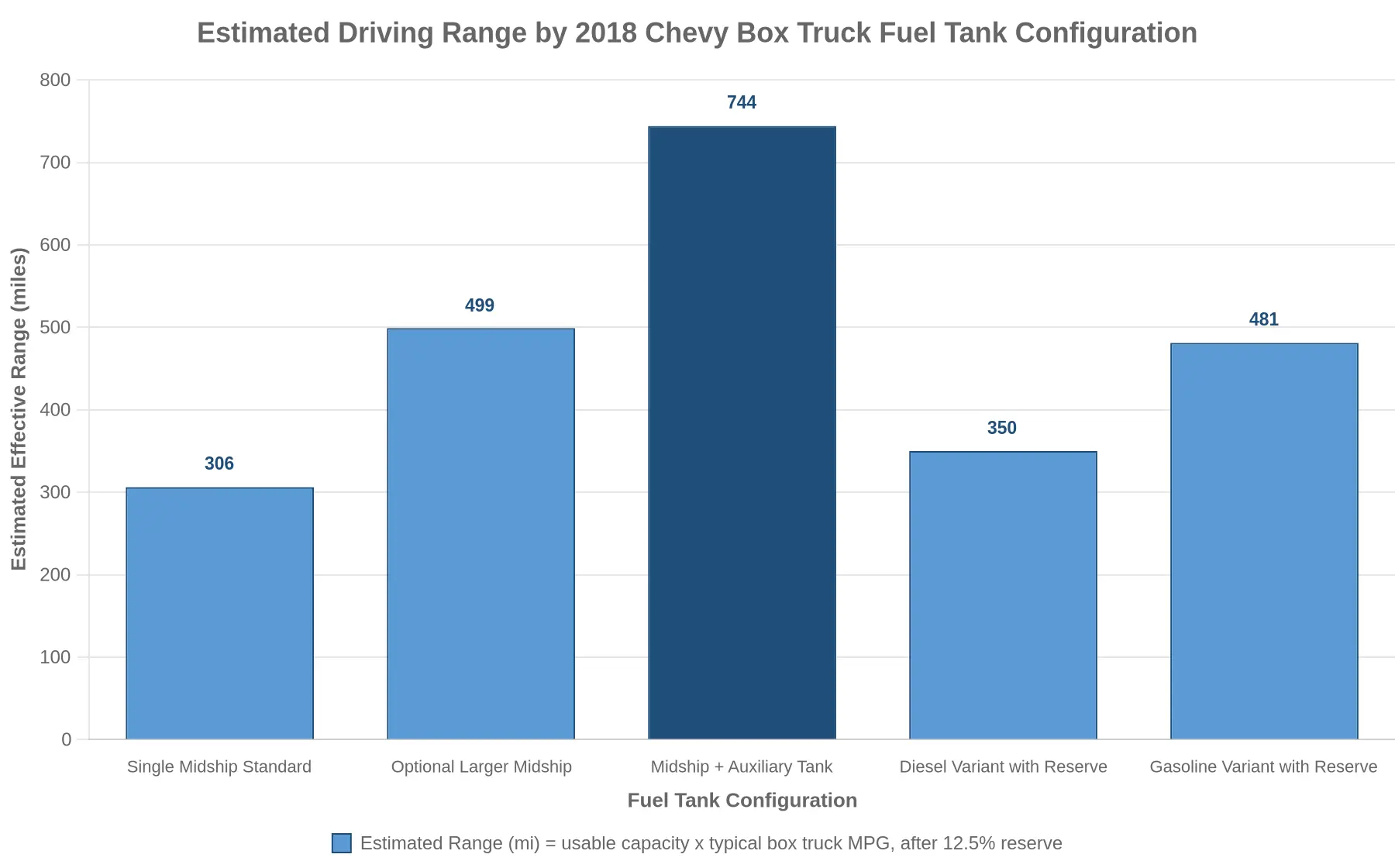
Figures are illustrative planning estimates based on typical capacity, MPG, and a 12.5% reserve assumption – not manufacturer guarantees.
Reading the numbers
The spread is wide enough to change how a shift is planned:
| Tank Configuration | Typical Capacity (gal) | Effective Range (mi) |
|---|---|---|
| Standard midship | 33 | 289 |
| Optional 55-gallon tank | 55 | 481 |
| Midship + 50-gallon auxiliary | 83 | 726 |
The standard 33-gallon tank covers a local delivery day but leaves little slack for detours and idling. The 55-gallon option buys roughly 190 more miles, often the difference between a mid-shift refuel and finishing on one fill. Add a 50-gallon auxiliary tank and the truck clears 700 miles, enough for multi-stop regional runs without a fuel stop built into the plan.
The 2.8L Duramax diesel returns better mpg and burns less at idle, so the same tank goes farther and suits longer routes. Gasoline trucks handle lighter local hauling, where a shorter range is easier to plan around.
Why the reserve matters more than the capacity number
A 15% reserve on a 33-gallon tank is about 5 gallons, which at 10 mpg is 50 miles of cushion that has to stay untouchable. Planners who count the whole tank as usable are the ones who end up hunting for a station at the worst possible moment. Build routes around usable range and a mid-shift refuel becomes a scheduled stop instead of an emergency.
Before locking in a plan, it helps to review the 2018 Chevy box truck gas tank size reference so your capacity assumptions match the actual spec sheet.
The takeaway: match the tank configuration to your longest realistic daily route, then plan around 85-90% of that range. The 55-gallon and auxiliary setups exist so that refueling happens on your schedule, not the road’s.
Mid-Shift Refueling Checklist for Fleet Managers and Operators
Before a 2018 cutaway leaves the yard on a route that might exceed one tank, run this pre-dispatch check. It takes about five minutes and prevents the roadside scramble that eats an afternoon.
- Confirm the actual tank capacity from the VIN build sheet, not the brochure number or the driver’s memory. Cutaway specs vary, and the 2018 Chevy box truck gas tank size may not match the sticker on a sister unit.
- Calculate usable range using real-world MPG, not the optimistic highway figure. Loaded trucks pulling against wind burn noticeably more fuel than an empty run.
- Subtract a reserve margin of at least 10 to 15 percent so the driver never coasts on fumes between stops.
- Identify approved mid shift refueling stops along the route, checking that each station can physically fit a box truck and trailer-height vehicle.
- Plan the stop timing around delivery windows, prioritizing refueling at natural breaks rather than during a tight appointment slot.
- Confirm diesel versus gasoline availability at each planned stop, since a gasoline unit cannot top off at a diesel-only commercial lane.
- Log the fuel level at both the start and end of the shift so dispatch can track burn rate and flag abnormal consumption early.
- Note whether an auxiliary tank is fitted and factor its volume into the total range calculation rather than treating it as a bonus.
Treat refueling as a scheduled event rather than a response to a warning light. Put fuel stops in the dispatch plan alongside delivery windows and driver hours, and a mid-shift stop becomes one more leg of the day. The result is fewer late arrivals, less driver stress, and range assumptions that hold up in real traffic.
Doing the Fuel Math: Capacity, MPG, and Usable Range
Every range estimate starts with the 2018 Chevy box truck gas tank size. Most gas-powered Express cutaway box trucks ship with the 33-gallon single tank, though some carry the 55-gallon aft-axle tank or an upfitter auxiliary. That is gross capacity, the volume the tank holds when filled to the brim. It is not the number you can spend on a route, and treating it as one is the most common planning error fleets make.
Real usable capacity is always lower. You should never plan to burn the last drop: the reserve protects the fuel pump, avoids sediment pickup, and covers detours, idling, or an unexpected headwind. Subtract a 10-15% reserve. On a 33-gallon tank, a 15% reserve leaves roughly 28 usable gallons; a lighter 10% reserve leaves about 30 gallons.
Next, multiply usable gallons by the truck’s typical MPG. A loaded 2018 Chevy box truck realistically returns about 8 MPG; an empty or lightly loaded one can reach 10-12 MPG. That yields roughly 224 miles loaded and up to about 280 miles near-empty. Because most routes combine driving and delivery segments, an average of 9-9.5 MPG is a reasonable planning assumption.
Now compare that figure to daily route mileage. Suppose a delivery route runs 260 miles at a 9.5 MPG average across mixed loads. One tank yields about 266 miles of usable range, so the driver finishes on a single tank but with almost no cushion. A small delay, a detour, or heavier loading could push consumption past the limit, so dispatch schedules a mid-shift stop anyway. Re-planning fixes it: trimming backhaul deadhead and resequencing stops cuts the route to 230 miles, comfortably inside the usable range. The refueling stop disappears and the truck completes the run on one tank.
The distinction that matters is gross versus usable. Gross is what the tank holds; usable is what a planner can assign to a route after the reserve. Multiply gallons by MPG to get distance, then use distance to make routing decisions. For deeper background on the tank itself, see the full breakdown of the 2018 Chevy box truck gas tank size.
An auxiliary tank changes the calculation entirely. Adding a 50-gallon transfer tank raises gross capacity to 83 gallons. After a 15% reserve that is about 70 usable gallons, or roughly 665 miles at 9.5 MPG. Mid-shift refueling drops out of the plan, and the same truck can absorb longer routes before any stop is required.
Turning Tank Size Into a Fleet Management Advantage
Tank size is a planning input, not a trivia point. When dispatchers know the real usable volume behind each vehicle’s fuel tank capacity, they can build routes around actual range instead of guessing. A truck that covers a full shift on one tank rarely stops mid-route, and that removes a chain of delays downstream. The number changes the route design before the truck leaves the yard.
A mid-shift refuel resets delivery windows. Every pump stop adds time, and an early one pushes later stops past their promised windows; a fifteen-minute stop can turn into thirty minutes of lost slack by mid-afternoon. Routes built on fuel range minus a safety margin avoid the problem. Schedule fuel at the end of a shift or at a cheap stop that does not break the route’s momentum.
Standardize Tank Configurations Across Similar Trucks
Mixed boxes add complexity. If every similar cutaway carries a different tank, drivers learn different ranges and planners lose comparability. Standardizing capacity, filler location, and fuel type across similar trucks lets one route template serve many vehicles, and it simplifies spare-part planning and fuel reporting. When sourcing replacements, teams often compare fuel tank manufacturers to find tanks that match OEM dimensions exactly rather than forcing an adapter or a custom bracket.
Let Fuel Data Drive Daily Decisions
Tank size does more when it is paired with telemetry. Fuel-level sensors, odometer logs, and fill records show whether a truck’s real-world range matches its rated capacity, and they expose idling losses, overstated ranges, and routes that consistently return on fumes. A few weeks of that data lets planners tighten route assignments and shift refueling to cheaper times. Fleets that track this closely often apply the same range planning to larger assets, including fuel tank capacity on semi trucks.
Factor Capacity Into Driver-Hours Planning
Hours-of-service and shift limits interact with tank size. If a truck needs two fuel stops per shift, those stops consume driving time and can shorten the practical delivery window. Planning driver-hours with fuel range built in keeps schedules realistic and reduces the pressure to rush. Over time, tank capacity becomes a scheduling variable as important as route miles and stop count.
A tank size sitting on a spec sheet changes nothing. Used for routing, standardization, data, and scheduling, the same figure shapes the fleet’s day.
The Mid-Shift Refueling Decision at a Glance
Before locking in a delivery sequence, run the numbers on your available range. The flow below is the logic a dispatcher or owner-operator follows: start with a full tank at dispatch, estimate real-world usable range, then ask the one question that changes everything: does that range cover the route? If it does, the run finishes without stopping. If not, plan a mid-shift refueling stop up front and adjust the remaining delivery sequence around it.
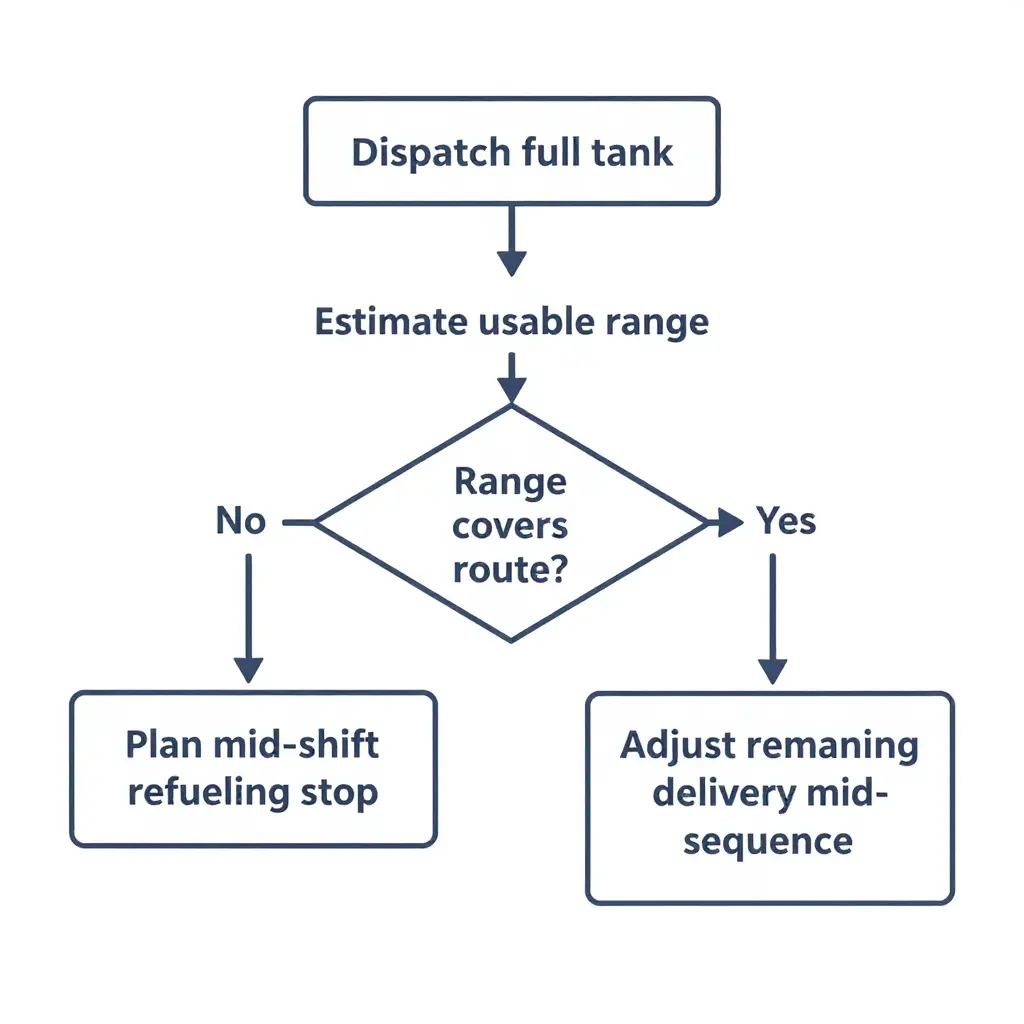
That decision is why fuel capacity is never just a spec-sheet number; it decides whether the day runs on schedule or stalls. The math starts with the truck in front of you, so it pays to confirm the real figures behind your 2018 Chevy box truck gas tank size before building the next route plan.
Frequently Asked Questions
What is the gas tank size on a 2018 Chevy box truck?
The 2018 Chevy box truck (Express Cutaway) comes with a 33-gallon fuel tank as standard equipment, and a 55-gallon aft-axle tank was offered on some configurations. Upfitters can add an auxiliary tank on top of that, so always verify the build sheet or door sticker. These figures are the 2018 Chevy box truck gas tank size baseline that many fleets build their route planning around.
Can I add an auxiliary fuel tank to a 2018 Chevy box truck?
Yes. Adding an auxiliary fuel tank is a common upfit. Aftermarket tanks typically mount in the frame rail or behind the cab and range from 30 to 60 gallons. They feed the main tank through a transfer pump or gravity line. Confirm GVWR and payload limits before installing, since a full auxiliary tank adds substantial weight. The payoff is a larger reserve without frequent stops.
How far can a 2018 Chevy box truck go on one tank?
With the standard 33-gallon tank and typical 10-12 mpg under load, expect roughly 290-350 miles per tank with a reserve held back. The 55-gallon option extends that to about 480-580 miles. Most operators plan fuel stops at 250-300 miles so a reserve margin remains, which keeps range predictable between scheduled stops.
Does mid-shift refueling really affect route planning?
Yes. A mid-shift stop of 15-20 minutes can shift the entire afternoon schedule. If a driver refuels at 200 miles instead of waiting for a terminal, dispatch must rebuild every remaining stop. Treating refueling as a planned waypoint rather than an interruption keeps delivery windows predictable and preserves a reserve margin across the day.
Does diesel vs gasoline change the 2018 Chevy box truck gas tank size?
No. Fuel type does not change the tank options. The 2018 Express Cutaway was offered with a 6.0L V8 gasoline engine and a 2.8L Duramax four-cylinder diesel, and both draw from the same 33-gallon and 55-gallon tank options. Diesel returns higher mpg, so driving range per tank grows even though capacity stays constant. A reserve margin still applies regardless of which fuel the truck burns.