
Introduction
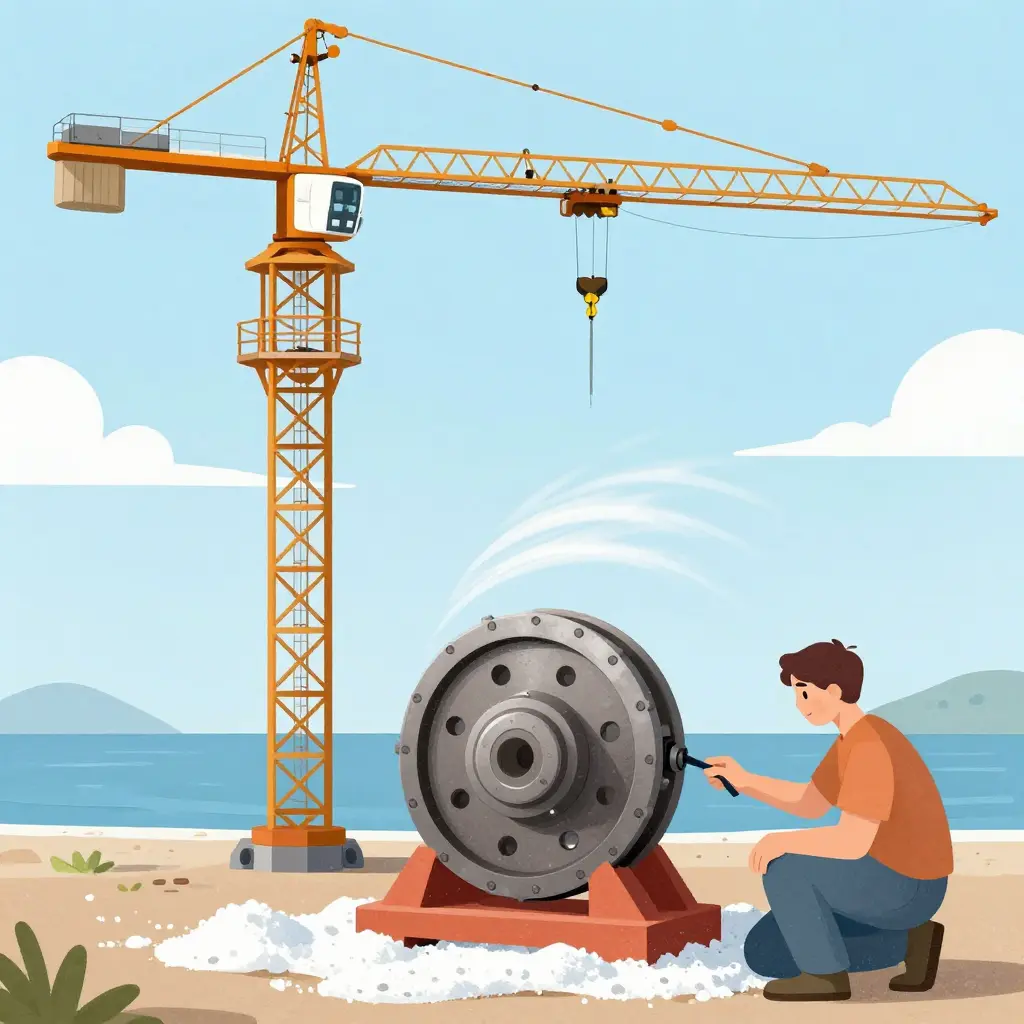
A tower crane’s slewing bearing carries the combined axial, radial, and moment loads between the mast and the rotating upper structure, so the jib can turn under load while the base stays fixed. When the ring fails, the crane stops. On a working site the downtime, mobilization costs, and safety exposure add up fast.
Coastal high wind sites are the hardest environment these bearings see, for three reasons. Salt-laden air attacks seals and raceway surfaces, breaking down lubricant films and starting corrosion pitting. Dynamic wind loading repeatedly flexes the connection and drives the bearing toward its fatigue and contact-stress limits, especially when the crane weathervanes in gusts. Moisture that gets past worn seals carries grit into the raceway, where it abrades the steel and accelerates wear.
None of this announces itself with one dramatic symptom. The damage compounds quietly: rotational torque rises, grease discolors, seals fail, the raceway spalls, and only then do clearance and vibration become measurable. By the time an operator feels sluggish or jerky slewing, the internal damage is usually well advanced.
Replacing a slewing bearing is a major, costly, safety-critical job. The inspection steps below are the ones that need to be completed before anyone signs off on a replacement, and they are laid out for maintenance engineers and crane operators working on site.
Why Coastal High Wind Sites Punish the Slewing Bearing
A coastal high wind site is not just a windy site. The wind there never really stops working on the machine, and the slewing bearing takes the brunt: it is the large-diameter ring that joins a tower crane’s rotating jib and counter-jib to the fixed mast. Inland, that bearing spends most of its life sitting still. At a port, a shipyard, or a shoreline high-rise project, it is nudged, pushed, reversed, and slammed day after day.
The first stressor is constant low-amplitude oscillation. Even on days that feel calm, dynamic wind load keeps the upper structure rocking through a few degrees of yaw – a tiny motion, but a relentless one. The raceway never stays properly seated, so rolling elements creep back and forth along the same narrow arc, lubricant is pushed aside, and the contact zone starts to fret. Over months this turns into false brinelling and shallow surface fatigue rather than a single dramatic failure.
Second is gust cycling. Coastal air is turbulent, so wind speed climbs and collapses within seconds. Each reversal loads the bearing one way, then the next gust unloads it and reloads it the other way. The reversals arrive abruptly and behave like shock loads, and the peak force in a single gust can far exceed the steady load assumed in the original design calculation.
The third is yaw braking with the wind parked on the bearing. Leave the crane parked with the yaw brake engaged and the wind keeps pushing. The brake holds the superstructure rigid while the mast wants to move, so the full yawing torque passes through the bearing as a peak load concentrated on a handful of rolling elements.
The three dominant stress types at coastal high wind sites are:
- Wind-induced oscillation – low-amplitude, near-continuous rocking that prevents the raceway from staying seated
- Gust shock loading – abrupt reversing loads as turbulent gusts build and collapse
- Slewing yaw braking torque – peak loads transferred through the bearing when the crane is parked and braked in strong wind
Taken together: coastal high wind does not break a tower crane slewing bearing with one overload. It wears the bearing down through constant small movement, then finishes the job with sharp gust cycles and locked-brake peak torque. That is why coastal inspection intervals should be shorter than inland schedules, and why a bearing that looks fine can already be on borrowed time.
| Failure Mode | Root Cause | Visible Indicator | Typical Time to Failure |
|---|---|---|---|
| Raceway spalling | Cyclic contact fatigue worsened by uneven load distribution and false brinelling from micro-vibration under gusty coastal high wind conditions | Flaking, pitting or dark metallic grooves tracking along the raceway path | 12-36 months (roughly 6,000-18,000 running hours at two-shift duty) |
| Roller / cage damage | Shock loads from load reversal plus insufficient or contaminated lubrication | Cracked or deformed cage, flat-spotted rollers, roller climb-up and metal debris in grease | 6-18 months |
| Seal degradation | Salt-laden air, UV and ozone attack, and abrasive sand breaking down the elastomer so moisture penetrates the bearing cavity | Cracked, hardened or swollen seals, water in the grease and grease weeping past the lip | 6-24 months |
| Corrosion pitting | Salt spray and condensation attacking exposed raceway and gear surfaces once the seals no longer exclude moisture | Rust streaks, brown-orange pitting and discolored or emulsified grease | 3-18 months |
| Bolt / gear wear | Fatigue and loss of preload at the mounting bolts combined with repetitive gear tooth loading | Elongated bolt holes, loose or stretched bolts, cracked weld toes and tooth pitting | 24-60 months |
Table 1. A slewing bearing failure mode map for tower crane systems at coastal high wind sites, linking each primary fault to its root cause, earliest visible indicator, and expected service life before replacement.
How Salt Spray and Moisture Ingress Drive Slewing Bearing Corrosion
A coastal tower crane lives in a permanent salt fog. Wind-driven chloride particles settle on every exposed surface, and the slewing bearing sits directly in that path. Most premature failures start here.
Stage 1: Seal Lip Wear Opens the Door
The elastomeric seal lips are the first line of defense. Continuous rotation, grit, and UV exposure wear the lip down and reduce its contact pressure against the raceway shoulder. Once the lip stops seating tightly, the bearing is no longer sealed in any meaningful sense, and salt spray has an open path inward.
Stage 2: Moisture Ingress and Contamination
Moisture follows gravity and capillary action. Rainwater and airborne salt migrate past the worn lip and pool in the lower quadrant of the raceway. The trapped brine mixes with depleted grease into an acidic, electrically conductive film that clings to the steel instead of draining away.
Stage 3: Electrochemical Corrosion on the Raceway
That film drives electrochemical corrosion. Chloride ions break down the passive oxide layer on the bearing steel. Where oxygen concentration varies across the contact surface, anodic and cathodic zones form; iron dissolves at the anode and precipitates as rust. The loss is localized rather than uniform, and it concentrates exactly where the rolling elements carry load.
Stage 4: Raceway Pitting and Spalling
The localized attack produces raceway pitting, and each pit acts as a stress raiser. Under the cyclic contact stresses of a working tower crane, subsurface cracks start at the pit edges and spread until the surface fractures and flakes away as spalling. Once spalling starts, the damage is progressive and irreversible.
Lubrication Breakdown Accelerates the Cycle
Saltwater emulsifies grease and destroys its additive package. Without a stable lubricant film, metal-to-metal contact increases and generates heat and abrasive debris. The debris polishes the raceway and exposes fresh steel, so corrosion and wear feed each other.
Summary: Inspection Priorities
For maintenance engineers the order matters: on coastal high-wind sites, check seal lip condition and lubrication chemistry first, then inspect the exposed raceway quadrant for discoloration and early raceway pitting. Catching moisture ingress at the seal stage costs far less than replacing a spalled slewing bearing.
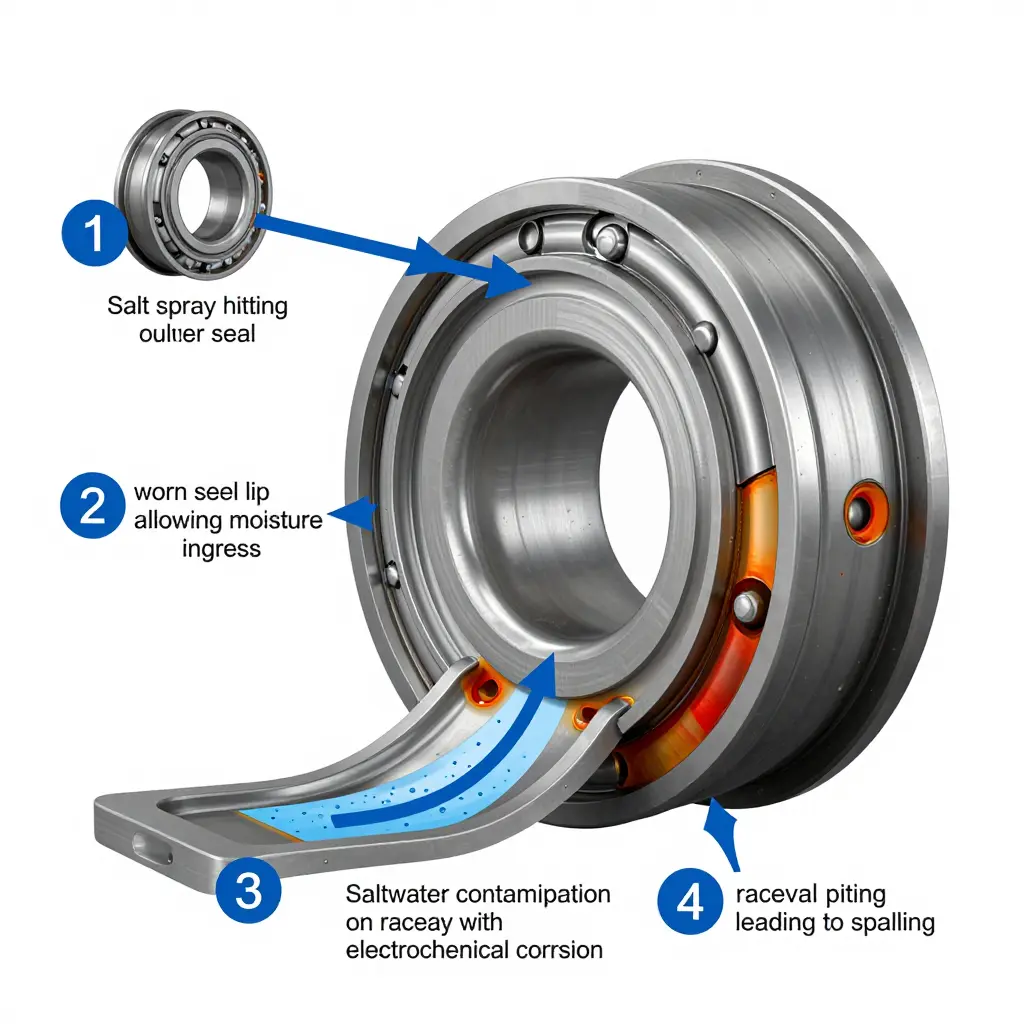
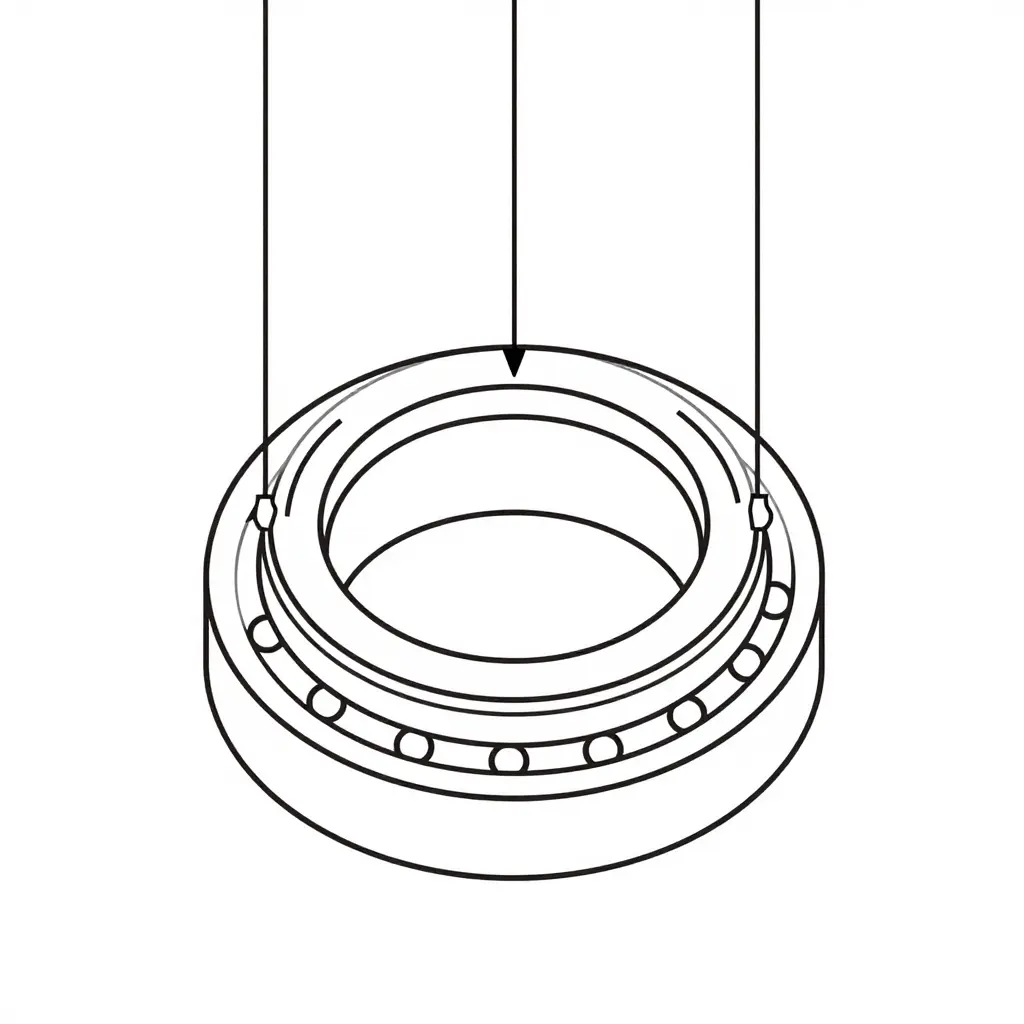
Figure: Cross-section of a tower crane slewing bearing, highlighting the inner ring, outer ring, rolling elements, raceway, and seal location – the exact zones where coastal moisture and salt attack the seal and raceway.
Lubrication Film Breakdown and Seal Degradation: The Compounding Failure Pathway
In a coastal high wind environment, lubrication is the slewing bearing’s first line of defense against salt spray, driven rain, and airborne grit. When it fails, the damage rarely stays isolated. Grease washout and seal degradation feed each other, and the bearing moves toward premature failure much faster than it would inland.
Grease Washout from Rain and Wind-Blown Moisture
At coastal high wind sites, rain seldom falls straight down. Gusts drive it sideways, forcing moisture past the lip of the seal and into the raceway, and salt-laden wind-blown spray makes it worse. Over time, water displaces the base oil in the grease, emulsifies the thickener, and pushes the lubricant out of the gap. What remains is a thin, contaminated film that can no longer carry the load or separate the rolling elements.
Hardening and Oxidation Under UV and Temperature Swings
Where grease survives the washout, the coastal climate keeps attacking it. Intense sunlight degrades the elastomer seal and the grease itself, while daily temperature swings between cool nights and hot, sun-exposed days make the grease expand, contract, and oxidize. It hardens into a crusty, varnish-like paste, its base oil bleeds away, and it can no longer flow back into the contact zones. Once grease stops flowing, it stops protecting.
Seal Degradation Opens the Door
Seal degradation is often the trigger that accelerates everything else. UV radiation, ozone, and thermal cycling crack and stiffen the seal material until it no longer wipes the raceway or excludes water. A hardened, split, or lifted seal turns a coastal high wind tower crane into an open system, so every rainfall and spray event reaches the bearing internals.
Metal-to-Metal Contact and Accelerated Wear
With the lubricant gone and the seal compromised, the rolling elements and raceway touch directly, metal to metal. Friction and micro-movement produce fretting, spalling, and progressive pitting. On a tower crane this wear shows up as rough slewing, backlash, and abnormal noise, and eventually as a bearing that can no longer be trusted under load.
Takeaway: Lubrication condition is the most reliable predictor of when a slewing bearing must be replaced. Grease washout, hardening, or a failing seal should trigger a scheduled replacement rather than a gamble on sudden failure in high wind.
Where Coastal High Wind Sites Hurt Slewing Bearings Most
The chart below shows how often each failure cause appears in field reports from tower crane slewing bearing inspections at coastal high wind sites. It is a Chart.js bar chart with five representative categories, reporting each cause as a share of all recorded failures.
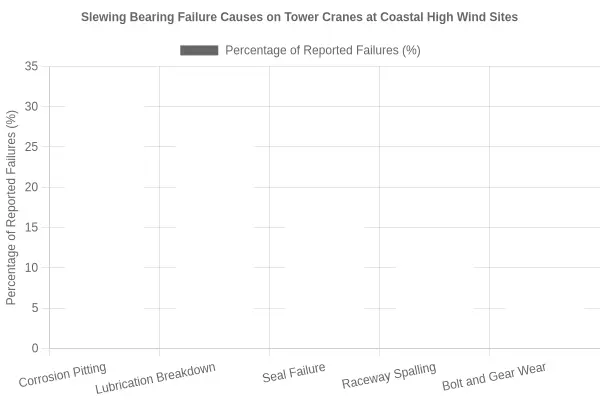
Caption: Corrosion pitting and lubrication breakdown together account for more than half of reported slewing bearing failure on tower cranes exposed to coastal high wind, dwarfing mechanical wear causes like raceway spalling and bolt and gear wear.
| Failure Cause | Percentage of Reported Failures |
|---|---|
| Corrosion Pitting | 34% |
| Lubrication Breakdown | 27% |
| Seal Failure | 18% |
| Raceway Spalling | 13% |
| Bolt and Gear Wear | 8% |
Salt-laden air puts corrosion pitting at the top of the list, and the constant flexing load from gusting coastal high wind drives lubrication breakdown close behind. Seal failure sits in the middle because a breached seal lets moisture and grit reach the raceway, feeding both of the leading causes. Mechanical wear trails well behind, which is why an inspection routine should start with corrosion and lubricant condition before anyone orders a replacement bearing.
Operators on coastal sites usually notice a change in the machine by feel, sound, and smell before a formal slewing bearing inspection confirms it. Salt-laden air, steady wind loading, and wide temperature swings accelerate wear inside the bearing in ways inland machines rarely experience. Catching those clues early is often the difference between a planned service window and a panicked replacement on the quayside.
Operator’s Quick Pre-Inspection Checklist
Work through this list at the start of every shift. If any item applies, log it and escalate to maintenance before the next big lift.
- Unusual slewing noise – A grinding, clicking, or rhythmic knocking sound during rotation usually points to raceway spalling, damaged rolling elements, or dry contact surfaces running metal-on-metal.
- Increased backlash – If the jib travels further than normal before the load responds, it signals clearance growth from worn races or loosened mounting bolts.
- Grease weeping at seals – Fresh grease pushing out around the seal line often means over-pressurization, a failing seal, or a blocked relief path forcing lubricant past its intended boundary.
- Rust staining – Orange streaks near the bearing ring or bolt circle reveal moisture ingress, and on coastal high wind installations salt corrosion bites into raceways surprisingly fast.
- Vibration during yaw – A shudder or judder as the crane swings suggests uneven load distribution, a flat-spotted rolling element, or a softening foundation beneath the bearing.
- Temperature rise at the bearing housing – A housing running noticeably hotter than usual indicates friction buildup, poor lubrication, or an alignment problem generating excess heat.
Why These Clues Matter
None of these signs on its own means the bearing is finished, but two or more appearing together are hard to explain away. Write down what you see and hear; it turns a vague complaint into a targeted diagnosis and gives the maintenance team a head start. The checklist feeds into the structured inspection steps – grease analysis, bolt torque checks, clearance measurement, and raceway assessment – that decide whether the crane keeps lifting or comes down for a rebuild.
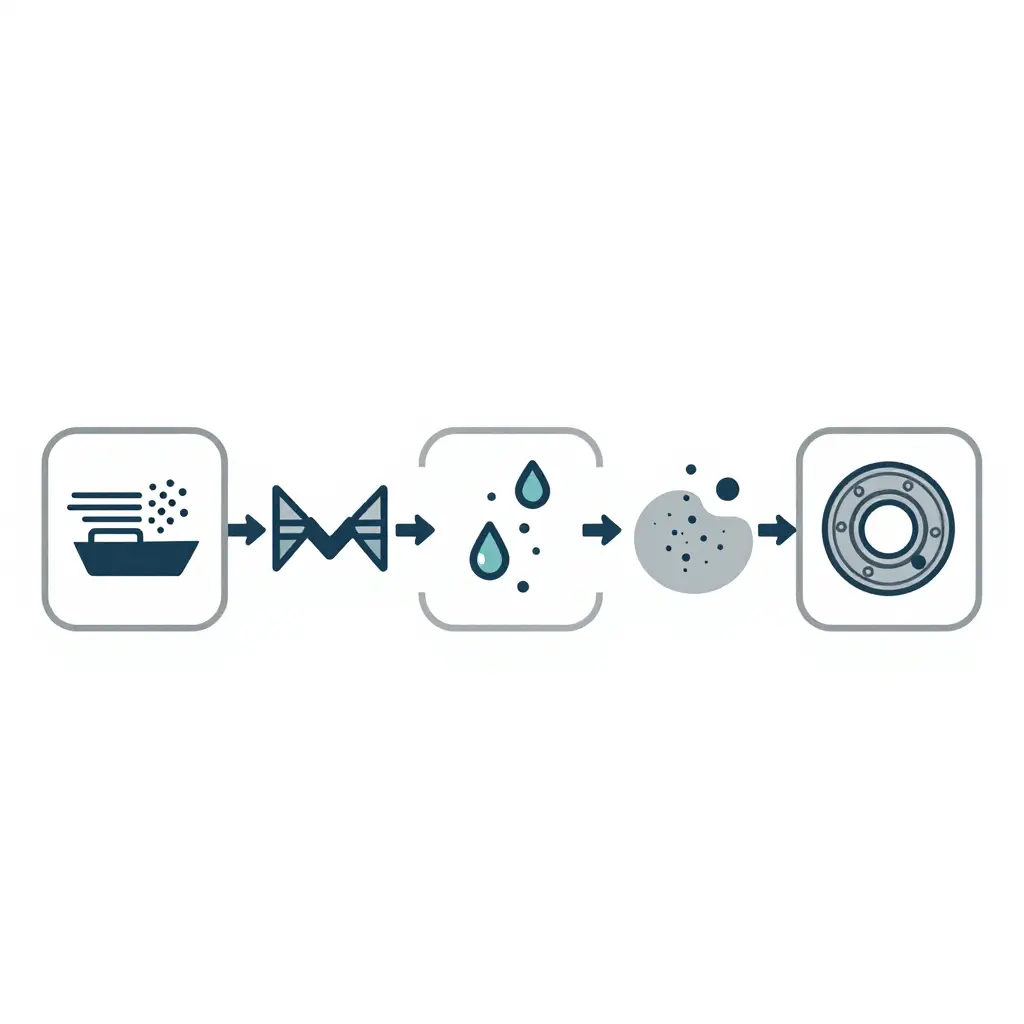
Figure: How coastal contaminants reach the slewing bearing raceway. The diagram traces a single failure path in five stages. First, the seal lip wears as abrasive salt crystals and grit work against the elastomer under repeated slewing and wind loading. Next, that wear opens a micro-gap along the sealing edge. Wind-blown moisture and saltwater droplets then drive through the gap, carrying fine dust and sand particles with them. Once inside, this mixture contaminates the grease, breaking down its film strength and carrying abrasives deep into the assembly. Finally, those contaminants reach the raceway contact, where they cause the pitting, spalling, and accelerated wear that force a replacement decision. The seal is the first line of defense, which is why stopping the failure at each earlier stage keeps it away from the raceway.
Wind-Induced Load Distribution Around the Slewing Bearing
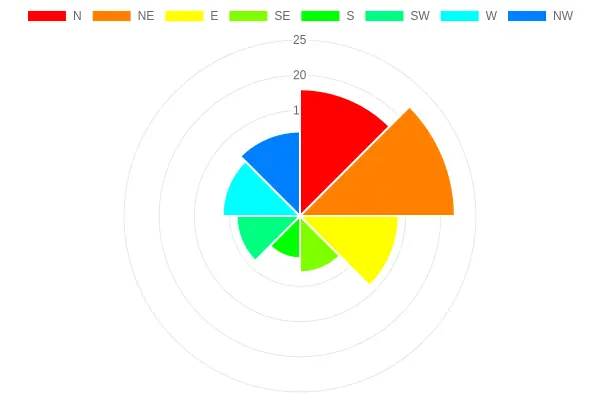
Before condemning a slewing bearing, it helps to know where the load actually goes. At a coastal high wind site, the wind rarely pushes uniformly on a tower crane. It drives the jib, counter-jib, and tower into a lopsided thrust pattern that rotates around the slewing bearing as the crane yaws. The polar area chart below breaks down that coastal high wind load distribution into eight compass-direction azimuth sectors, using Chart.js polarArea type so you can pick out which side of the raceway carries the heaviest share.
| Azimuth Sector | Share of Wind-Induced Load |
|---|---|
| N | 18% |
| NE | 22% |
| E | 14% |
| SE | 8% |
| S | 6% |
| SW | 9% |
| W | 11% |
| NW | 12% |
Uneven coastal high wind load distribution concentrates wear on specific raceway segments of the tower crane slewing bearing.
The profile is lopsided: the NE and N sectors carry 40% of the total load between them, while the sheltered S and SE sectors see about a third of that. The rollers, raceway, and gear teeth sitting under the high-load arc wear far faster than the lightly loaded side, and that is where spalling, brinelling, or a widening backlash reading usually shows up first during a pre-replacement check.
Replace vs. Monitor: A Decision Matrix for Coastal Slewing Bearings
In a salty, gust-battered environment, gut feeling is not a maintenance strategy. Every reading from an inspection should map to a clear, defensible action. The matrix below compares what you observe against a measurement threshold and points to the right call – keep watching, repair, or commit to a full replacement.
| Observed Condition | Measurement Threshold | Recommended Action | Urgency Level |
|---|---|---|---|
| Minor surface corrosion on raceway or housing | Rust film under 0.5 mm, no pitting or flaking | Clean, apply marine-grade protective coating, re-inspect in 3 months | Low – continue monitoring |
| Seal weeping / light grease seepage | Seepage under 5 ml per day, no grit or water ingress | Schedule seal replacement at next planned downtime | Medium – schedule repair |
| Backlash within tolerance | 0-15 arc-minutes, stable across readings | Log monthly, keep monitoring for drift | Low – continue monitoring |
| Backlash out of tolerance | Above 30 arc-minutes, or a sudden jump between checks | Plan a slewing bearing replacement, restrict lift cycles | High – plan replacement |
| Visible raceway spalling | Any flaking, pitting, or metallic debris in grease | Immediate slewing bearing replacement, lock out crane | Critical – stop operation |
| Abnormal noise or shudder under load | Vibration spikes, grinding audible during slew | Inspect gear mesh and bolts, isolate cause before restart | High – investigate now |
| Uneven or accelerated tooth wear | Gear tooth thinning over 10 percent of original profile | Order replacement parts, reduce duty cycle in the interim | Medium – schedule repair |
| Loosened or elongated ring bolts | Torque loss beyond OEM limit or visible bolt stretch | Retorque to spec, replace any stretched bolts, re-verify | High – act this week |
Caption: This matrix helps inspectors decide when a tower crane slewing bearing replacement is genuinely unavoidable at coastal high wind sites – and when continued monitoring is the smarter, more cost-effective choice.
FAQ: Slewing Bearing Failure and Pre-Replacement Inspection on Coastal High Wind Tower Crane Sites
How often should a slewing bearing be inspected at a coastal site?
Monthly for a visual check, and every three to six months for a detailed inspection covering dimensions, backlash, and grease analysis. Salt spray, blowing sand, and persistent humidity accelerate wear far faster than inland conditions, so these intervals are shorter than a standard maintenance schedule. After any storm or extended period of sustained high winds, add an unscheduled inspection before the crane is put back into service.
What causes premature corrosion in a slewing bearing?
Most often, salt-laden air gets in through worn, cracked, or wrongly seated seals, and the grease has degraded to the point where it can no longer displace moisture. Once chloride-rich water reaches the raceways and rolling elements, pitting begins and quickly progresses to spalling. Using a grease that is not rated for marine exposure, or re-greasing too infrequently, is the most common maintenance-related root cause.
Can a slewing bearing be repaired instead of replaced?
Once raceway or rolling-element damage is confirmed, a slewing bearing generally cannot be repaired reliably and has to be replaced. Raceways and rolling elements are hardened components held to very tight tolerances, so welding, grinding, or patching them compromises load capacity and operational safety. Minor seal or grease problems can be corrected in place, but structural damage to the rings requires a full replacement.
What warning signs require immediate shutdown?
Shut the crane down when operators detect abnormal noise, roughness, or binding during rotation, visible grease leakage around the seals, or a sudden rise in rotational resistance. Cracks, metal flakes, or heavy rust weeping from the bearing joint also demand an immediate stop. Any of these signs means the slewing bearing can no longer be trusted to carry rated loads under high wind, and continued operation risks a catastrophic failure.
How does high wind affect slewing bearing life?
High wind applies repeated, reversing loads to the tower crane’s slewing system, which accelerates fatigue on the raceways and rolling elements. At a coastal high wind site, this dynamic loading combines with salt corrosion to shorten service life sharply. The constant micro-movements also push grease aside, leaving contact surfaces under-protected exactly when they need lubrication most.
What records should be kept before replacement?
Before replacement, document the full set of pre-replacement inspection findings: dated photographs of corrosion and damage, torque and backlash measurements, grease sample results, and total operating hours. Record the wind history, all maintenance dates, and any prior repairs to establish a clear failure timeline. These records support warranty claims, refine the maintenance schedule, and provide a performance baseline for the new bearing.
Conclusion: Turning Inspection Into Action
On coastal high wind sites, a tower crane slewing bearing rarely fails for a single reason. Corrosion, inadequate lubrication, and uneven load distribution work together, accelerated by salt-laden air, relentless wind buffeting, and the punishing slewing demands of lifting in exposed conditions. Salt spray attacks seals and raceways, poor lubrication allows metal-on-metal contact, and misaligned or lopsided loads concentrate stress on a narrow band of rolling elements. Recognizing these drivers is only half the job. The other half is disciplined follow-through on the inspection steps outlined above: measure, document, compare against tolerances, and never wave through a check that feels routine.
Before starting any slewing bearing replacement, treat preparation as seriously as the lift itself. Assemble the full documentation package: OEM specifications, service history, prior inspection reports, and current tolerance records for axial and radial play, gear backlash, and raceway wear. Record every measurement precisely, because those numbers become your baseline for accepting the new bearing and detecting future deterioration. Coordinate early with your lifting team to confirm crane capacity, rigging points, load charts, and weather windows, since coastal high wind can shut down a lift with little warning. Order the correct bearing and sealing kit, stage corrosion-resistant fasteners, and brief every technician on torque sequencing and contamination control.
Deferred maintenance almost always costs more than planned maintenance, a lesson proven repeatedly in fleet equipment, where the hidden costs of ignoring propane tanker truck weights tend to surface at the worst possible moment. Prepare thoroughly, inspect honestly, and document everything.
A slewing bearing replacement done right extends the working life of your tower crane and protects every crew member working beneath it.