
Low Price Septic Tank Trucks: Why the Sticker Is Not the Real Cost
In liquid-waste hauling, the invoice price of a septic tank truck tells you very little about what it will cost to own. A discount up front is often paid for later through thinner tank plate, cheaper vacuum components, and shorter service intervals; the bill arrives months down the road as repairs and lost billable hours. For fleet owners and procurement managers, the number that matters is total cost of ownership, and on a septic truck two things drive it: how thick the tank steel is, and how fast the vacuum pump wears.
Tank steel thickness. A vacuum tank shell has to hold off external atmospheric pressure while its interior is evacuated, survive the fatigue of repeated fill-and-discharge cycles, and stand up to sludge and sewage. Its steel thickness, measured in gauge or millimeters, sets the margin against vacuum buckling and supplies the sacrificial metal that corrosion eats before a leak appears. Plate that is too thin cuts weight and price, but it also shrinks that margin and the corrosion allowance, so leaks, weld cracks, and a full re-shell arrive sooner.
Vacuum pump wear. The pump is the working heart of the truck, and its wear is cumulative and almost entirely irreversible. As clearances between vanes, lobes, or rotors and their housings widen, slip increases, airflow falls, and the pump runs longer to move the same volume. That extra runtime compounds heat, seal degradation, and bearing stress, pushing a unit toward rebuild or replacement years earlier than its rated service life.
Neither driver is visible at the point of sale, which is why a lower purchase price so often hides a higher lifetime cost. Understanding the true cost of septic tank truck ownership starts with these two variables rather than the invoice. The sections below take them in turn and show how tank steel thickness and vacuum pump wear shape acquisition, operating, maintenance, and resale economics.
How Steel Thickness Drives Septic Tank Truck Durability and Payload
For a fleet or procurement manager, the wall thickness of a vacuum tank shell is not a detail you can wave off. It drives structural survival, corrosion life, and how much revenue-bearing waste a truck can legally carry. Two shells that look the same from the outside can fail in months or run for a decade, and the difference usually comes down to a few millimeters of plate.
Hoop Stress and Vacuum Collapse Resistance
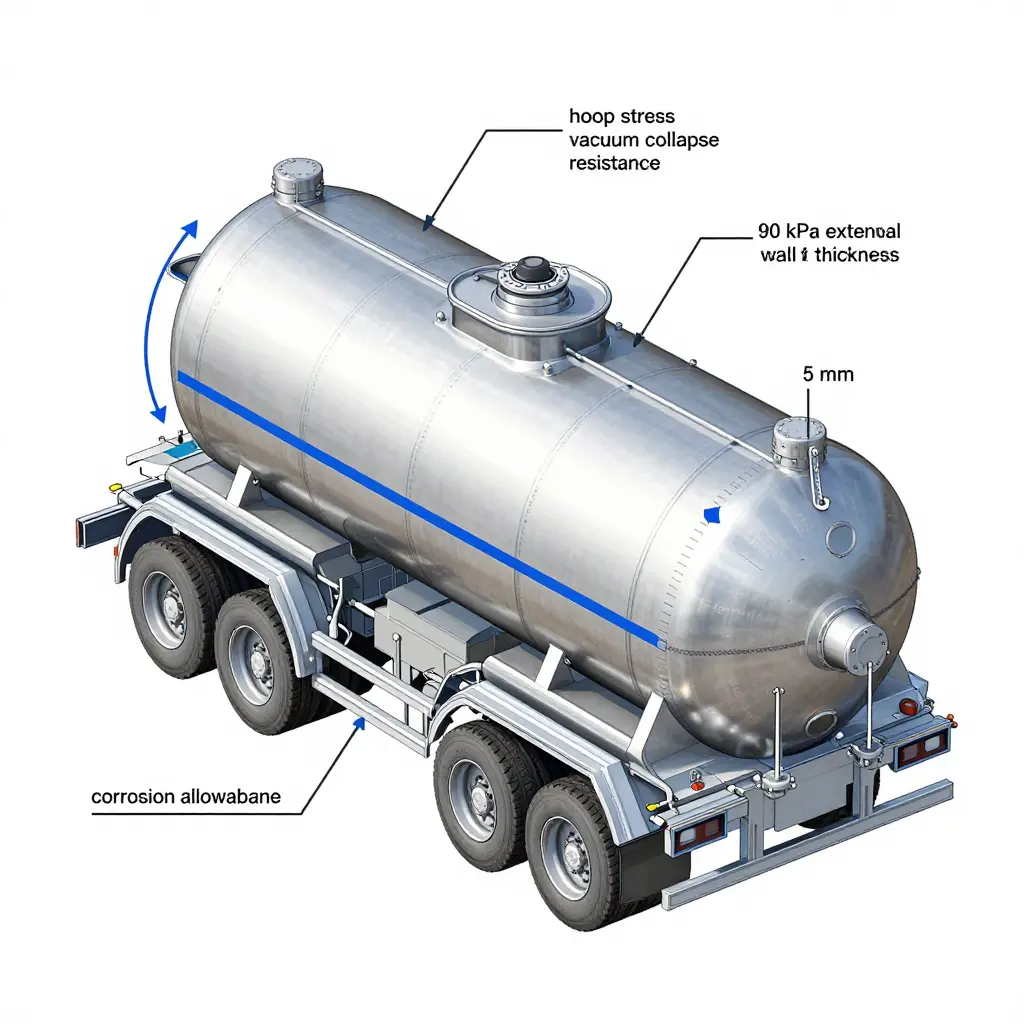
A cylindrical vacuum tank takes load two ways: a little internal pressure during discharge, and much more importantly, external atmospheric pressure when the pump pulls a vacuum.
Hoop stress in the wall follows the thin-wall relationship σ = P·D / (2·t), where P is pressure, D is tank diameter, and t is wall thickness. Because t is in the denominator, thinner plate multiplies stress at the same duty cycle.
Under vacuum, that same wall becomes a buckling problem. External pressure collapses the shell once it exceeds a critical value that scales roughly with (t/D)³, so small reductions in thickness cause disproportionately large drops in collapse resistance.
Thicker plate raises that critical buckling pressure and keeps the shell inside its design margin. A documented vacuum rating should therefore be tied to a specified plate thickness, not to a generic “heavy-duty” label.
Denting, Fatigue, and Corrosion-Related Failure
Every pump cycle flexes the shell. Thin-gauge steel accumulates that cyclic strain faster and starts fatigue cracks at welds, baffles, and manway penetrations, the usual initiation points in vacuum service.
Thicker steel also soaks up impact from debris and road shock, resisting the dents that concentrate stress and shorten service life.
Corrosion is thickness-sensitive in a subtler way. A pitting allowance of, say, 1.5 mm is a quarter of a 6 mm shell but half of a 3 mm shell. Thin steel therefore perforates years earlier, turning a routine inspection into an unplanned tank replacement.
The Weight-Payload Trade-off
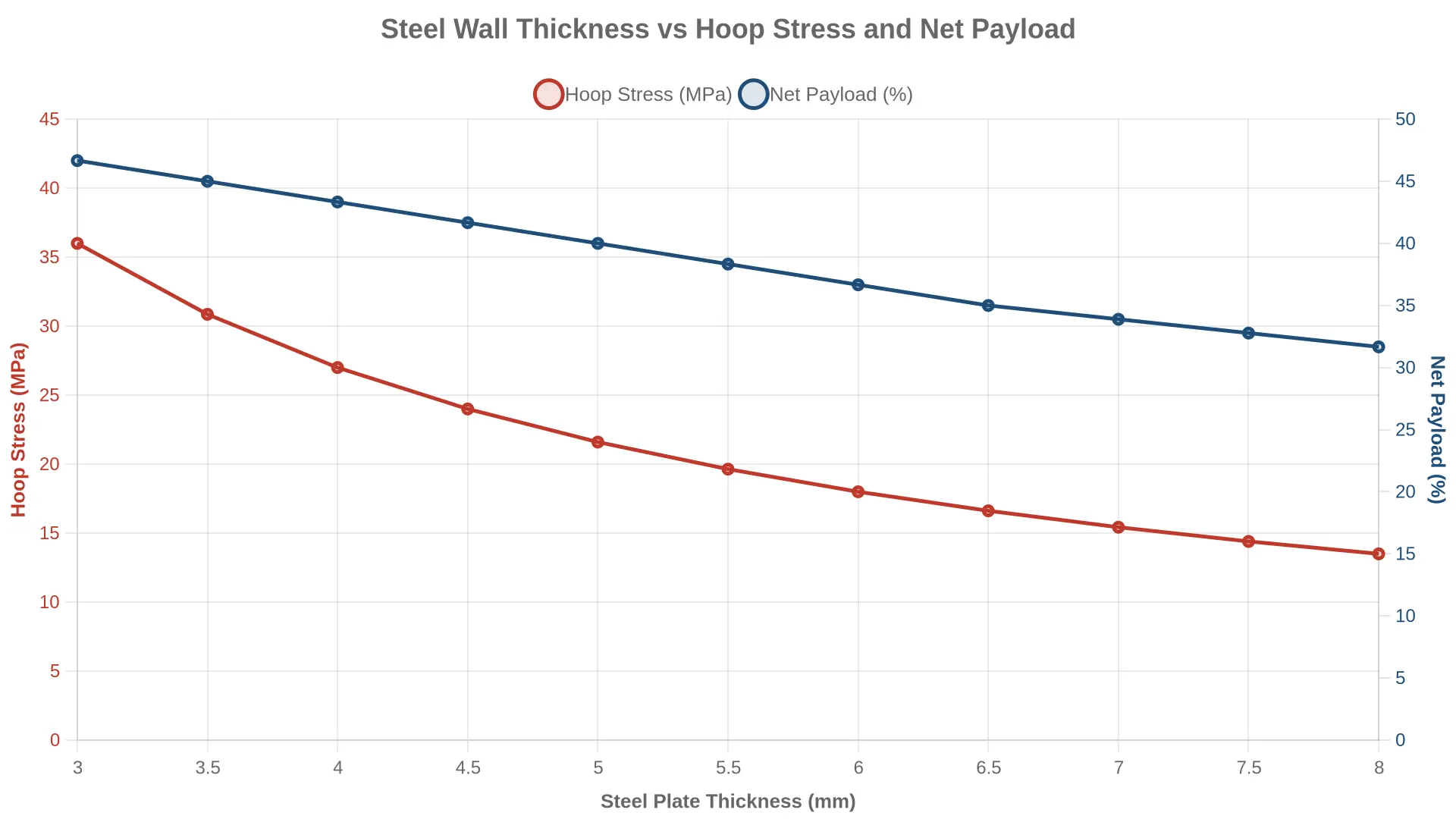
Adding steel increases the tank’s own weight and cuts net payload under a fixed GVWR. The table below, illustrative for a 3,000-gallon shell on a 33,000 lb GVWR chassis, shows the trade-off. On this chassis the legal liquid load is set by the payload column, not by the tank’s full volume.
| Plate Thickness (mm) | Shell Self-Weight (lb) | Available Payload (lb) |
|---|---|---|
| 3 | 1,150 | 12,850 |
| 4 | 1,530 | 12,470 |
| 5 | 1,900 | 12,100 |
| 6 | 2,280 | 11,720 |
| 8 | 3,040 | 10,960 |
The engineering answer is rarely “as thick as possible.” It is the thickness that meets a documented vacuum rating and a quantified corrosion allowance while leaving usable payload. Shaving steel to lower the sticker price usually just moves the cost into weld repairs, extra pump strain, and early retirement.
For how these variables reshape acquisition budgets, see the real cost of a septic tank truck.
Tank Steel Thickness: Specifications vs. Long-Term Cost
Wall thickness is the most decisive cost driver over a tank truck’s life. It shapes corrosion rates, repair intervals, and resale value long after anyone remembers the sticker price.
| Steel Thickness | Typical Tank Service Life | Corrosion Risk | Typical Repair Frequency | Relative Long-Term Cost Impact |
|---|---|---|---|---|
| 3 mm (approx. 11 gauge) | 5-7 years | High; rapid pitting and wall-thinning | Frequent; patch welds every 12-18 months | Highest; recurring downtime and early replacement |
| 4 mm (approx. 8 gauge) | 7-10 years | Moderate to high in aggressive slurries | Occasional; repairs every 2-3 years | High; steady recurring maintenance cost |
| 5 mm (approx. 6 gauge) | 10-15 years | Moderate; manageable with internal coatings | Infrequent; repairs every 4-5 years | Balanced; strong cost-per-service-year |
| 6 mm (approx. 3 gauge) | 15-20+ years | Low; generous corrosion allowance margin | Rare; minor repairs beyond 6 years | Lowest annual cost; highest upfront outlay |
How Vacuum Pump Wear Governs the Real Cost of a Septic Tank Truck
Sticker price says almost nothing about what a septic truck costs to own. The vacuum pump is the heart of the machine, and how fast its internal clearances open up decides the real cost: suction lost, minutes added to every pump-out, extra diesel, and the day you finally write a check for a replacement pump. Understanding how that wear happens is what separates a truck that earns its keep from one that drains margin.
Where Vacuum Pump Wear Actually Comes From
A rotary vane or lobe pump depends on tight clearances between its rotor, vanes, and housing. Anything that erodes those clearances erodes airflow with it, and the damage comes from five predictable sources:
- Abrasive solids. Sand, grit, and sludge drawn past a saturated moisture trap behave like grinding compound, wearing vane tips and cylinder walls.
- Cavitation. Slugs of liquid and collapsing vapor bubbles pit the rotor and housing, one micro-collision at a time.
- Continuous duty cycles. Pumps run flat out all day never get the cool-down that intermittent duty allows, so heat stress builds.
- Inadequate lubrication. A vane pump that briefly runs dry loses its oil film and suffers friction spikes almost instantly.
- Heat. Sustained high temperatures thin lubricant, open up clearances, and accelerate every other mechanism on this list.
The Measurable Consequences of Wear
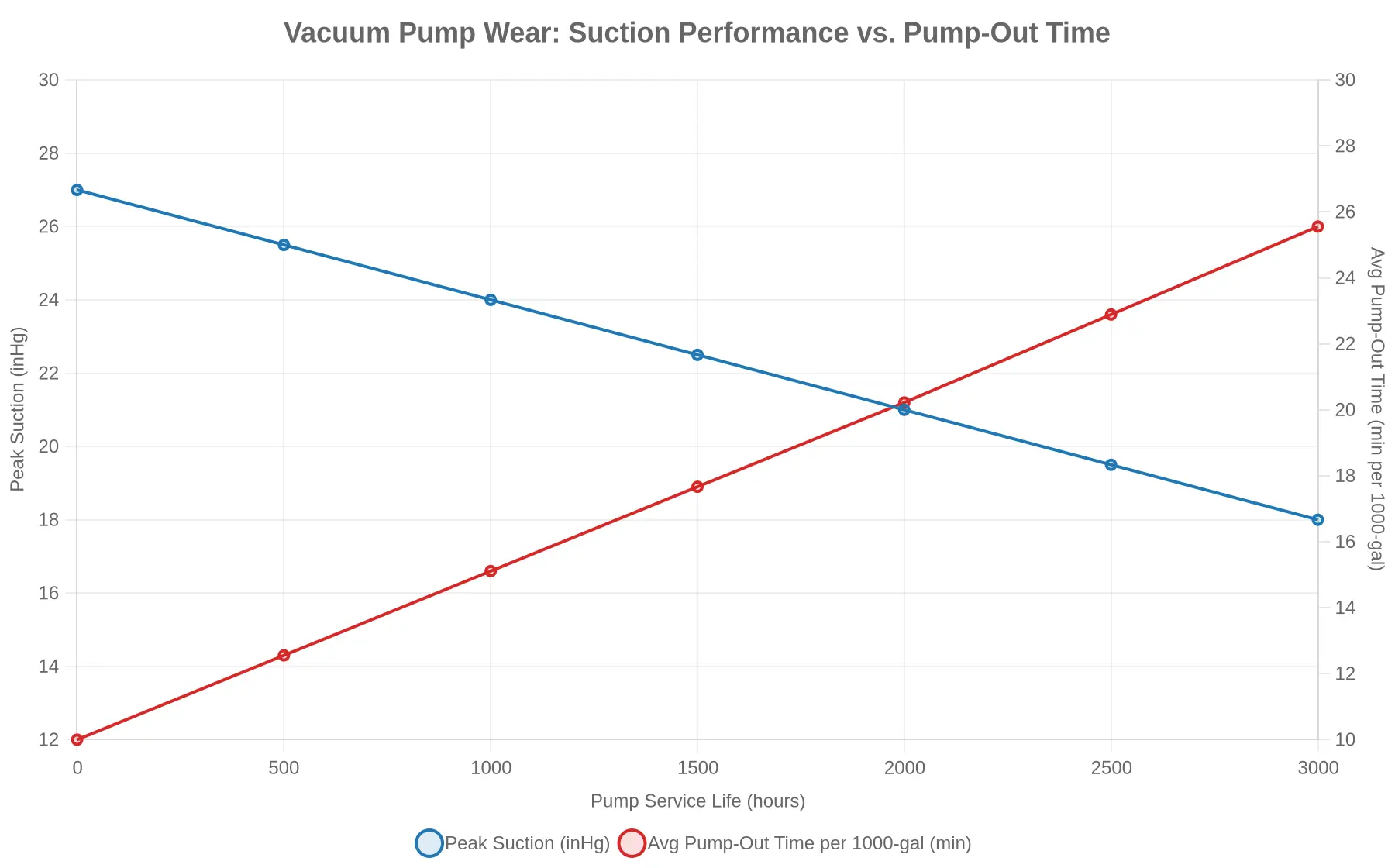
Wear rarely announces itself; it shows up in the numbers. Peak suction drops first, so a load that once took twelve minutes to pull stretches toward twenty. That lost suction feeds straight into fuel, labor hours per stop, and how many sites a crew can finish in a shift. Eventually the pump cannot pull a full load at all, and it gets replaced early.
| Wear Indicator | What It Signals |
|---|---|
| Falling vacuum gauge reading under load | Vane and lobe tip clearance out of spec |
| Longer fill and discharge times | Lost airflow and declining suction performance |
| Rising oil consumption and case heat | Internal friction and lubricant breakdown |
| Metal debris in the moisture trap | Active abrasion of the rotor and housing |
Duty Rating and Steel Thickness Demand
Here pump selection stops being a label and turns into a structural requirement. A continuous-duty pump runs hotter and longer, so the shell and baffles it works against have to resist both vacuum stress and thermal cycling. Thin plate sized for an intermittent-duty unit flexes under the loads a continuous-duty pump produces, and that mismatch is behind a lot of premature failures, leaks, and tank distortion. For more, see this breakdown of where vacuum pump and tank baffle ratings mismatch.
Abrasive solids, cavitation, duty cycles, lubrication, and heat each take a little life out of the pump, and each one turns that wear into money. Track suction and pump-out time as operating metrics and match the pump’s duty rating to the steel holding it; the truck’s real cost becomes visible long before the invoice arrives.
This comparison tracks eight years of cumulative ownership costs, showing how a low-price truck’s cheaper sticker price is steadily overtaken by rising repair, downtime, and pump replacement expenses.
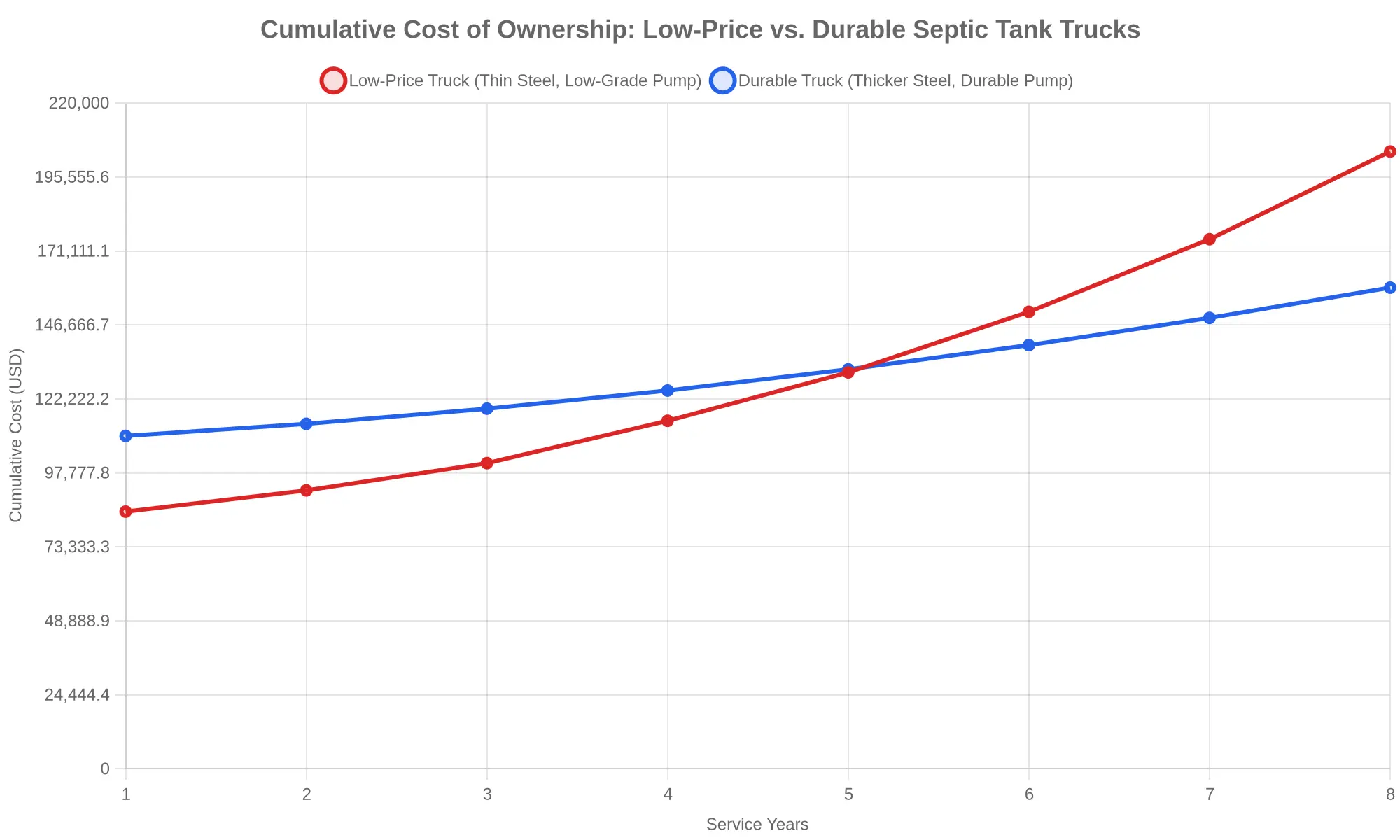
As the crossover point near Year 3-4 shows, the durable truck’s higher upfront price pays back within the first few years of service, which is worth knowing before you finalize any septic tank truck purchase decision.
What to Verify Before Buying Any Septic Tank Truck
A septic truck’s true cost hides in its steel, its pump, and its paperwork. Run this checklist before you sign, so a low sticker price does not turn into a repair-heavy liability.
- Steel thickness certification: Demand mill test reports (MTRs) confirming plate gauge, for example 4 mm versus 6 mm, against the quoted build specification rather than a sales sheet.
- Steel grade and source: Verify the plate grade and origin, since under-spec or recycled steel corrodes faster under constant vacuum stress.
- Vacuum pump duty rating: Confirm continuous-duty versus intermittent rating against your daily pumping cycles, required CFM, and displacement needs.
- Pump wear history: On used units, pull maintenance logs, operating hours, and records of vane, seal, and bearing replacement.
- Tank baffle condition: Inspect baffle welds, cracks, and corrosion at the partition, since failing baffles compromise structural integrity and load control, especially where pump and tank baffle ratings mismatch.
- Corrosion inspection: Check internal and external surfaces for pitting, weld-line rust, and lining failure, and ask which corrosive loads the tank previously carried.
- Paperwork and certification: Verify tank certification, pressure and vacuum test records, DOT and roadworthiness documentation, and a clean title before payment.
- Expected service intervals: Confirm OEM-recommended intervals for pump overhaul, valve rebuild, and tank inspection against your actual duty cycle.
- Hoses, valves, and relief hardware: Examine discharge hoses, ball and gate valves, and vacuum relief valves for wear, correct sizing, and proper function.
- Warranty and parts availability: Confirm coverage terms, exclusions, and local parts supply to protect uptime and resale value after purchase.
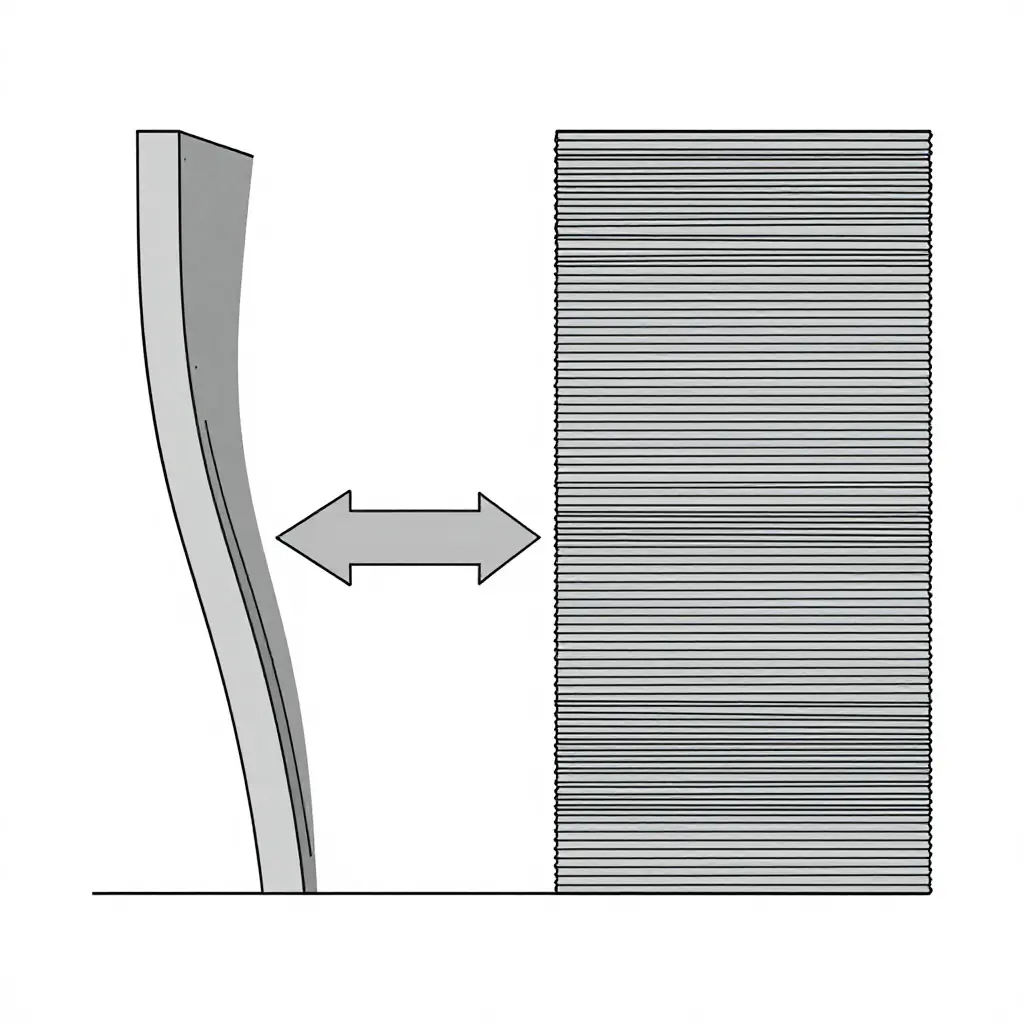
Cross-section of a septic tank wall comparing thin-gauge and thick-gauge steel: vacuum and liquid loading forces act on the wall, and greater plate thickness resists inward deformation and buckling.
How Steel Thickness and Pump Wear Interact to Determine Real Cost
The sticker price of a septic tank truck is the least reliable predictor of what it will cost you. The real number sits where two systems meet and push against each other: the steel shell that holds the load and the vacuum pump that moves it. Spec either one too cheaply and they do not fail on their own; they speed up each other’s decline. How tank size and pump type split the price is only the start. Their interaction is what settles ownership cost.
The Cost Multiplication Loop
Start with a thin tank wall. Under vacuum it flexes. Each pump cycle pulls the shell in a little and lets it back, and that repeated flexing works the welds, seams, and baffles that hold the tank together. Flexing also opens small gaps in coatings and seams, so effluent reaches bare steel, and septic waste is aggressive. The rust that follows is not cosmetic. It thins the wall further and makes the next cycle flex more.
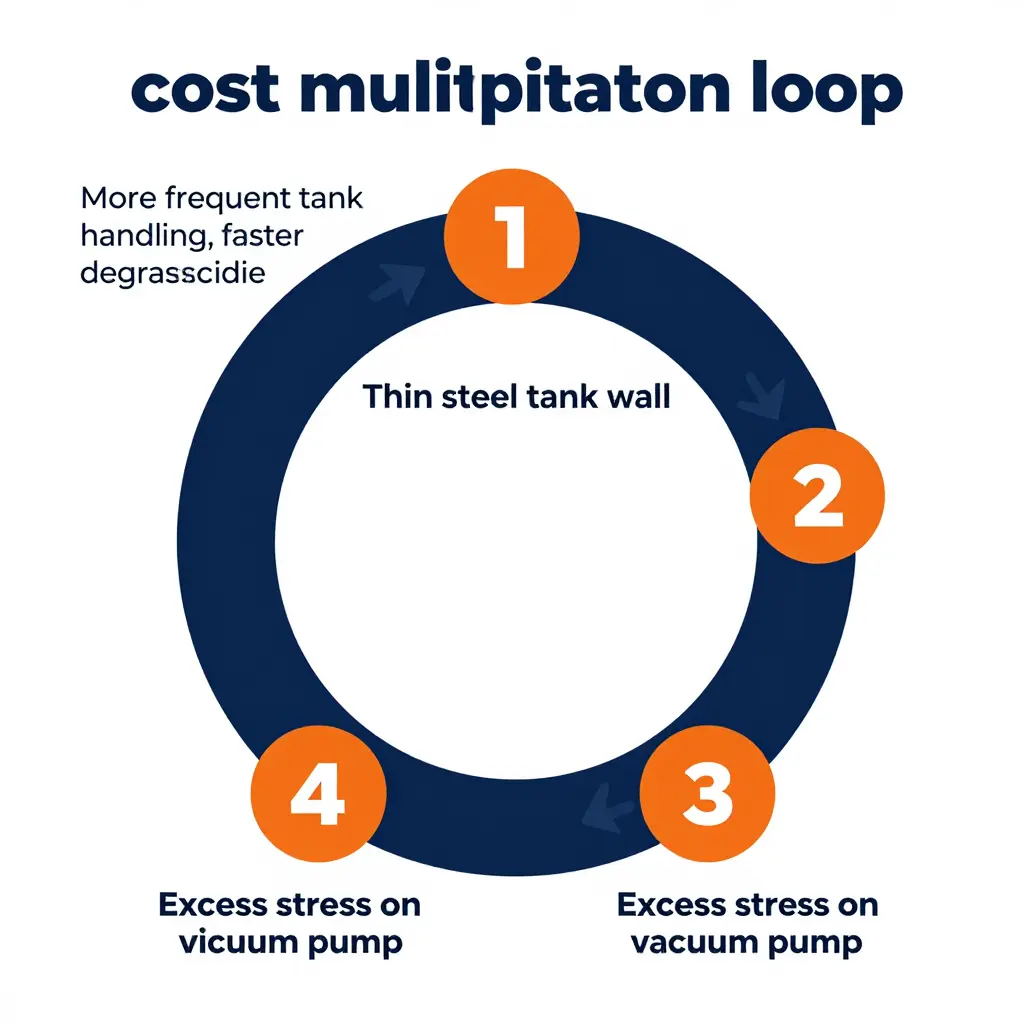
Now add the pump. A pump pulling against a flexing, leaking tank has to work harder to hold pressure. It runs hotter, its seals and vanes wear faster, and it loses efficiency. A worn pump cannot pull a full load in one pass, so the driver makes more trips, runs more cycles a day, and puts the weakened tank through even more flexing. That is the cost multiplication loop: thin steel stresses the pump, the failing pump stresses the tank, and every turn shortens the life of both. Cheap parts do not just fail sooner; they make each other fail faster. Anyone shopping low-price septic tank trucks for sale should know the loop is built in before the first load is pumped.
Why the Cheaper Truck Can Cost More Per Gallon Pumped
Lifetime economics can be counterintuitive. The cheapest truck on the lot usually wins on day one and loses over a decade. The way to see it is to put everything on the one metric that matters in the field: cost per gallon pumped.
A thick-wall tank with a correctly sized pump holds pressure, resists corrosion, and keeps its efficiency flat for years. A thin-wall tank with an undersized or low-grade pump degrades on a rising curve, slowly at first and then steeply. Its cost per gallon starts low and climbs as downtime, repairs, lost load capacity, and early replacement add up.
The engineering is simple. Steel thickness sets how long the tank resists flexing and corrosion. That sets how much stress the pump absorbs, which sets how long the pump lasts, which sets how often the tank is handled, dumped, and stressed again. Each link multiplies the next instead of adding to it.
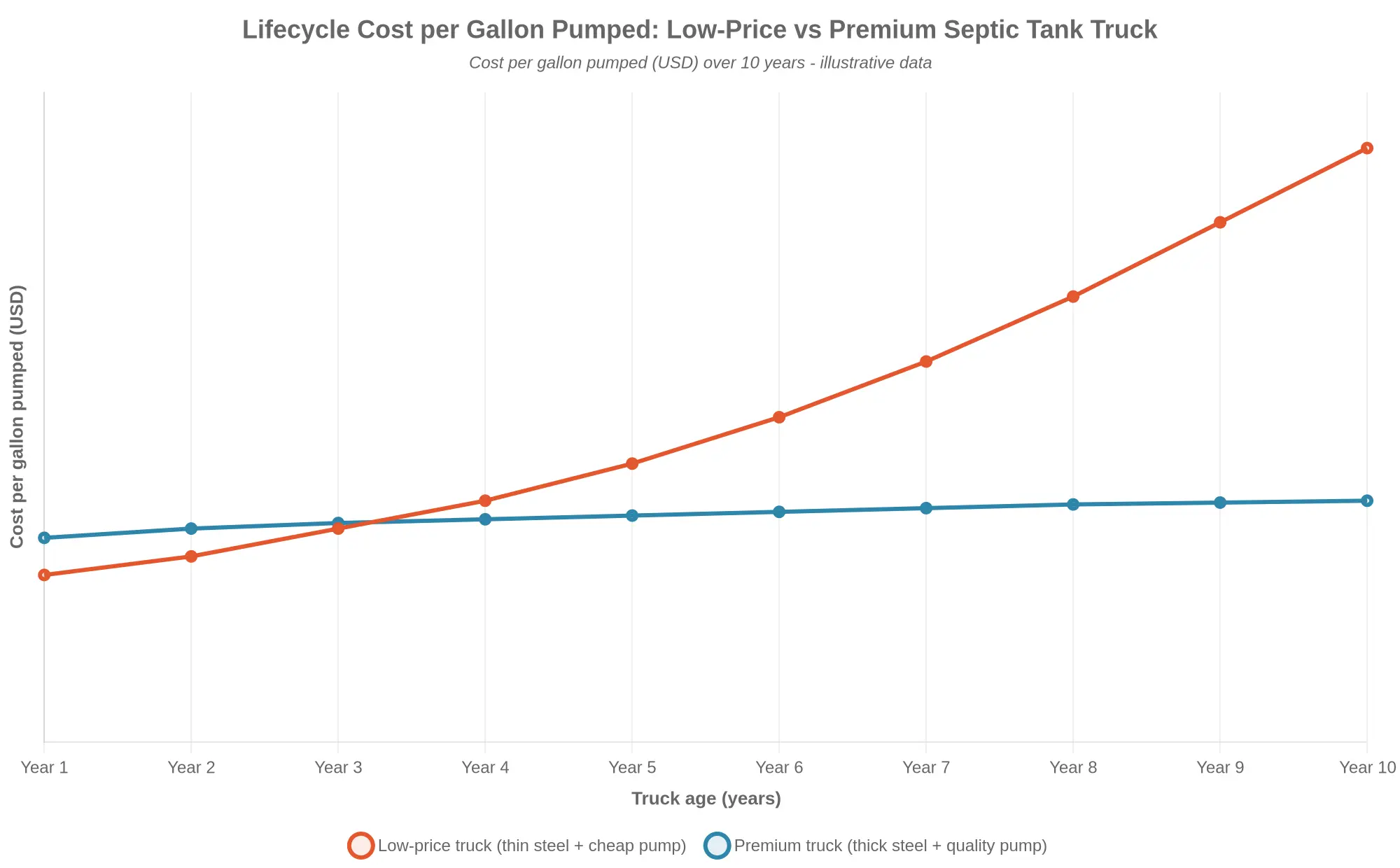
When you look at used or budget equipment, treat the tank wall and the pump as one wear couple, not two separate line items. A cheap truck up front is not really cheaper; it just finances a higher cost per gallon, paid back later in repairs and lost working hours.
The Real Cost of a Septic Tank Truck Lives in the Steel and the Pump, Not the Sticker
The case for buying carefully is simple: a low asking price is a headline, not a verdict. Over a working life measured in thousands of pumping cycles, two engineering facts dominate total cost of ownership. The first is tank steel thickness, which sets corrosion resistance, structural integrity under continuous vacuum load, and how long the barrel resists dents, fatigue, and corrosion before it needs repair or replacement. The second is pump wear. Vane and lobe erosion, seal degradation, and bearing fatigue steadily cut throughput and reliability, turning a cheap asset into an expensive one through downtime and lost service calls.
Cost-of-ownership reasoning turns the usual comparison around. Instead of ranking trucks by purchase price, disciplined buyers model fuel and maintenance, consumable rebuild intervals, pump overhaul frequency, and residual value against real duty cycles. A truck with thicker, properly spec’d steel and a pump sized to the actual workload often returns a lower cost per gallon over its life, even with a higher purchase price. The metrics that matter are durability metrics: shell thickness tolerances, baffle and reinforcement ratings, pump flow and vacuum ratings matched to tank volume, and a documented inspection history.
Procurement verification turns those principles into a checklist. Confirm steel thickness against the specification, not the sales sheet. Match pump capacity to the tank and the job. Insist on valid certification and inspection records; mismatched or incomplete paperwork is what delays handover when fleets buy in volume. Check service logs, leak tests, and component provenance before money changes hands.
Going forward, the strongest fleets will treat septic tank trucks as long-horizon capital assets, not opportunistic buys. As margins tighten and uptime becomes the real differentiator, decisions grounded in steel integrity, pump condition, and verified documentation will beat those chasing the lowest sticker price. Buying carefully is not caution for its own sake; it is what protects fleet economics over the years.