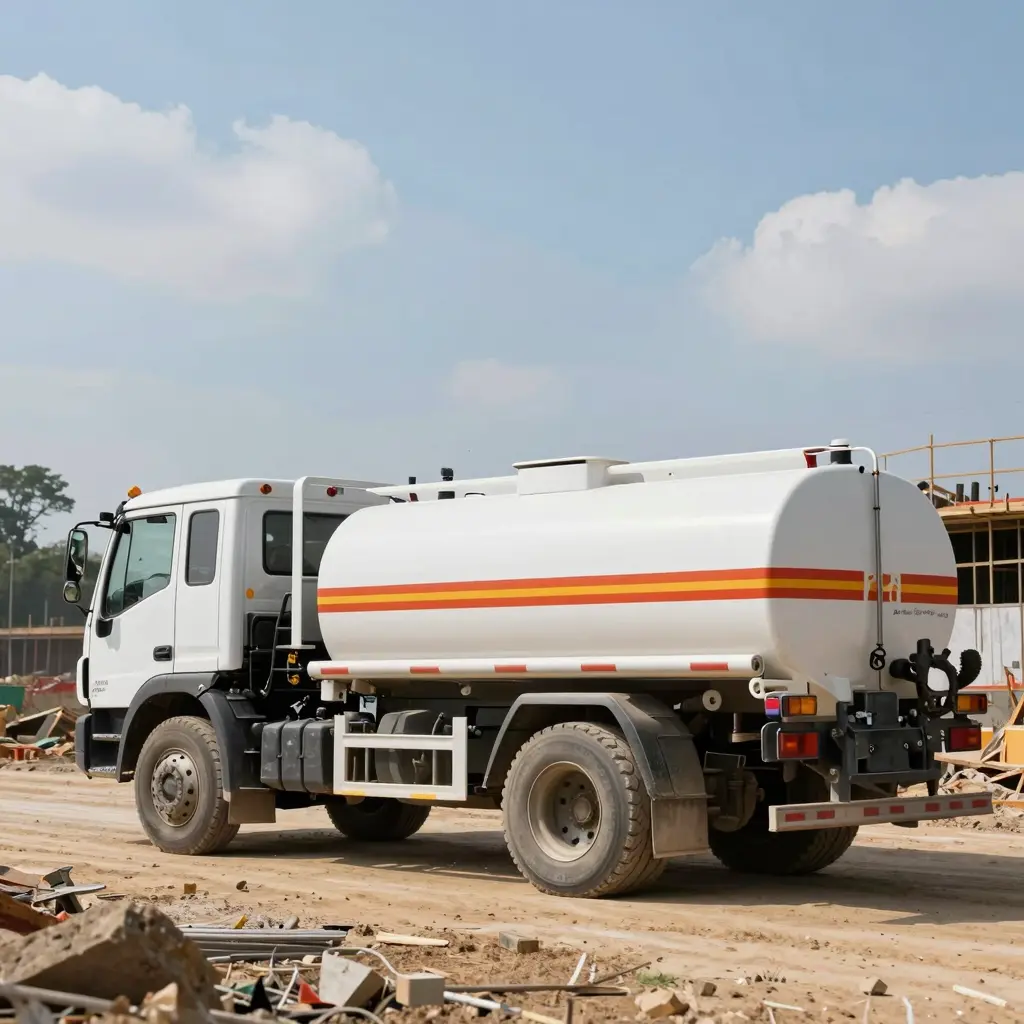

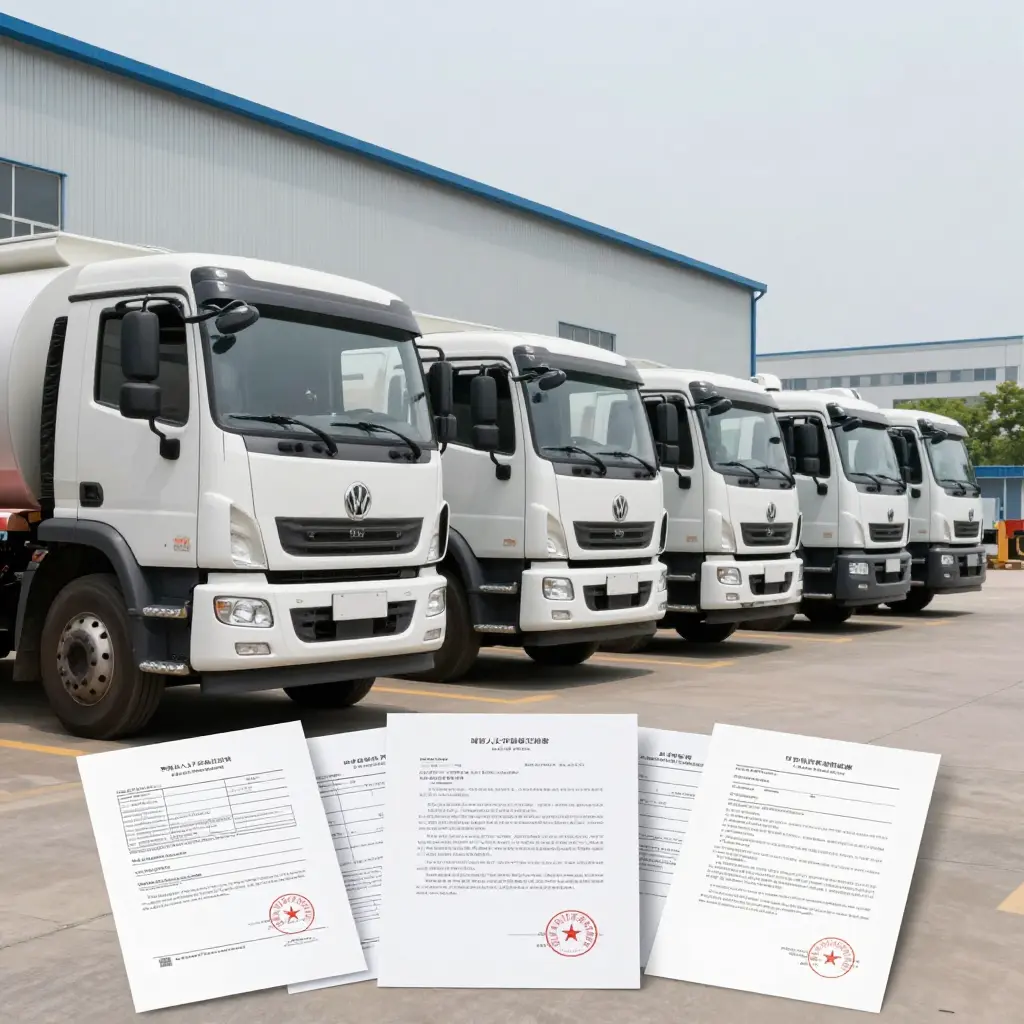
Buying Septic Tank Delivery Trucks in Wholesale Lots: Why Tank Certification Paperwork Stalls at Pickup
Buying septic tank delivery trucks in wholesale lots ties up serious capital and leaves little slack in the schedule. For septic service companies, waste disposal businesses, and wholesale truck dealers, the case for taking several vacuum and septic units at once is easy to make: unit economics improve, freight is consolidated, and fleet expansion happens on a predictable schedule. What usually goes wrong is not the trucks. It is tank certification paperwork – the regulatory documentation that confirms a tank’s material grade, weld integrity, pressure-test records, and compliance status – and it most often triggers pickup delays at the factory or port.
This guide is for fleet managers, septic service operators, waste disposal businesses, wholesale truck dealers, and procurement managers who buy commercial vacuum and septic trucks in volume. It explains where the documentation checkpoints sit, why fleets lose days or weeks at them, and what procurement teams can do before collection day. If you are still choosing units, available septic tank delivery trucks is a useful starting point on configurations and supply channels.
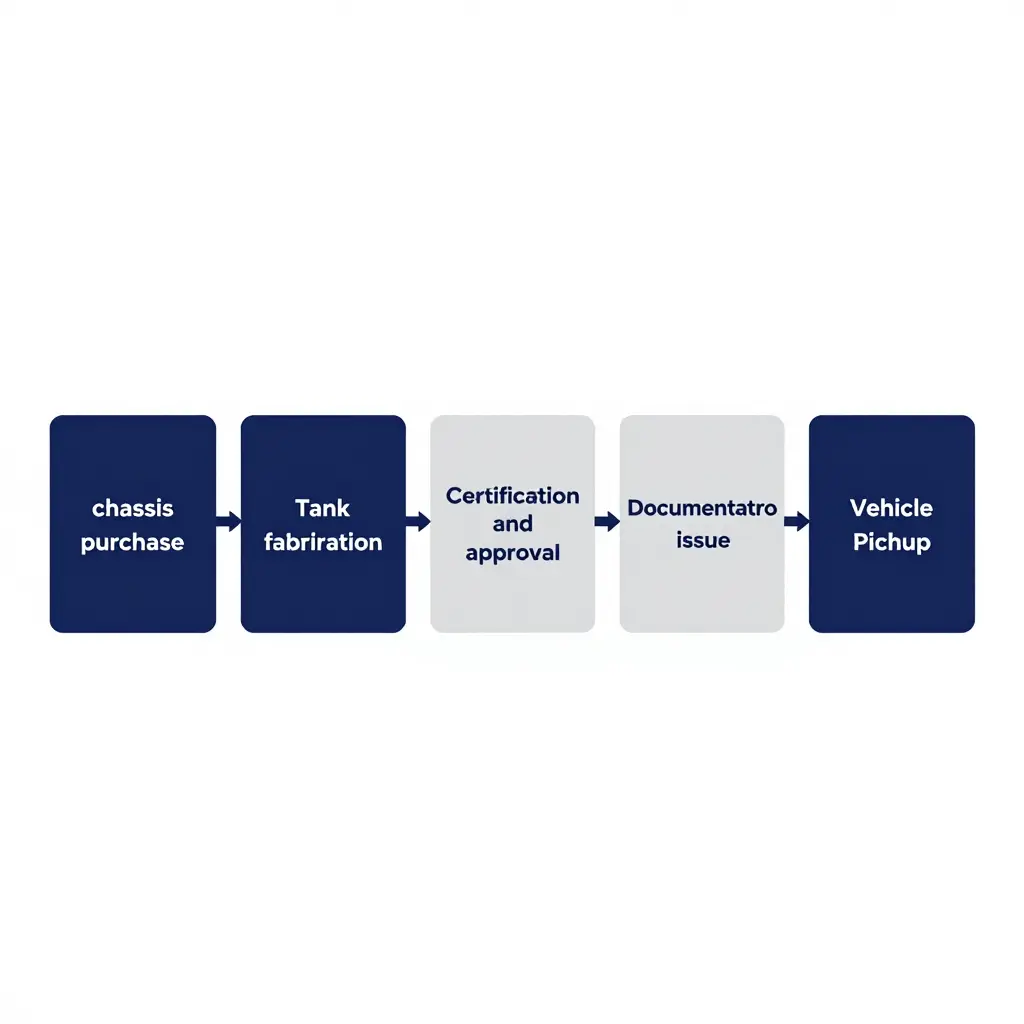
The Regulatory and Safety Basis for Tank Certification Paperwork
Every septic tank delivery truck carries a paper trail that matters as much as the steel underneath it. Tank certification paperwork is the documented proof that a unit’s tank, baffles, and pump were designed, built, and pressure-tested to recognized engineering and transport standards. Without it a vehicle cannot be legally registered, insured, or dispatched from the lot, however well it runs. For buyers sourcing wholesale septic tank trucks, the paperwork is the license to operate, not an administrative afterthought.
What the Certifications Actually Confirm
Pressure and vacuum ratings. A vacuum tank is a pressure vessel working in reverse. It must hold a defined vacuum while loading and withstand positive pressure while discharging without deforming, cracking, or collapsing. The certificate records the tank’s rated limits and the test results behind them.
Baffle ratings. Internal baffles control liquid surge, which affects braking, cornering, and rollover risk. Their welds, spacing, and load ratings are certified because a baffle that fails mid-transit turns a manageable load into a moving hazard.
Weight and axle-load compliance. Regulators enforce gross vehicle weight and per-axle limits, and the tank’s own weight, its rated capacity in gallons, and the distribution across axles all have to fit inside legal bounds. Certification ties the tank specification to the chassis so the loaded truck stays compliant on public roads.
Transport documentation. The manifest, spec sheet, and conformity records travel with the truck. Inspectors and insurers use them to confirm that the vehicle on the road matches the vehicle that was approved. Missing or conflicting documents are a common reason units stall before they leave the lot, particularly when vacuum pump and tank baffle ratings mismatch between the factory build sheet and the final inspection.
Why Formal Certification Is Required
Regulators require it because an uncertified tank is an unquantified risk to the public, the driver, and the environment. Manufacturers require it because vacuum tank truck certification shifts liability and defines warranty boundaries. Together they create a chain of accountability from design through fabrication, testing, and delivery. A truck with clean, matching paperwork can legally leave the lot, pass inspection, and get insured. Buyers who treat certification as a checklist item rather than a threshold to clear end up with breakdowns, fines, and rejected deliveries.
Certification Requirements by Regulatory Authority
The table maps the core certification and documentation requirements for septic tank delivery trucks sold in wholesale lots, showing which authority issues each document and how long each one can stall a pickup.
| Requirement Type | Responsible Authority | Typical Document Issued | Impact on Pickup Timeline |
|---|---|---|---|
| Tank pressure test certificate | DOT / state tank safety board | Hydrostatic pressure test certificate | 3-5 day delay if certificate is expired or missing |
| Baffle rating documentation | Manufacturer / NHTSA oversight | Baffle load-rating specification sheet | 1-2 day verification hold when specs are undocumented |
| Weight and axle-load compliance | State DMV / FMCSA | Axle-weight compliance report | 1-3 days for certified scale verification |
| Emission and safety inspection | State environmental agency / DOT | Emissions and safety inspection sticker | 2-7 days if re-inspection is required |
| Transfer of title and registration | State DMV / county tax office | Title transfer and registration record | 3-10 days processing before legal release |
| Manufacturer conformity statement | Manufacturer / NHTSA | FMVSS conformity statement | 1-2 days for document retrieval and validation |
Pre-Pickup Documentation Checklist for Wholesale Septic Tank Trucks
Before you dispatch a driver or authorize a transporter to collect a unit, confirm that every document below is present, current, and matched to the exact truck you are buying. One gap in the file can turn a same-day pickup into a multi-day stall, so make verification a hard gate rather than a formality.
- Pressure/vacuum test certificates – valid, in-date, and referencing the tank serial number for the specific unit being collected.
- Baffle rating sheets – showing baffle type, material, and rated flow capacity for the installed tank configuration.
- Tank specification sign-off – an approved build sheet confirming capacity, compartment layout, and pump mounting points.
- Weight and axle-load compliance records – certified scale tickets and axle distribution figures that sit within legal road limits.
- Emission and safety inspection reports – current engine emission compliance plus a passing safety inspection document.
- Manufacturer conformity statement – a formal declaration that the chassis, tank, and pump meet the applicable build standard.
- VIN-to-documentation match – verify the chassis VIN, tank serial, and pump serial all reconcile across every piece of paperwork.
- Complete title transfer paperwork – signed title, bill of sale, lien release, and any required odometer disclosure.
Walk the list line by line, flag any missing or mismatched item in writing, and release the pickup only once every box is ticked and the documents are scanned into your fleet file. That habit keeps the delivery schedule predictable and stops a truck from sitting idle while regulators or lien holders chase paperwork.
For a closer look at how vacuum pump and baffle specifications should line up on factory sheets, review these septic tank truck factory specs.
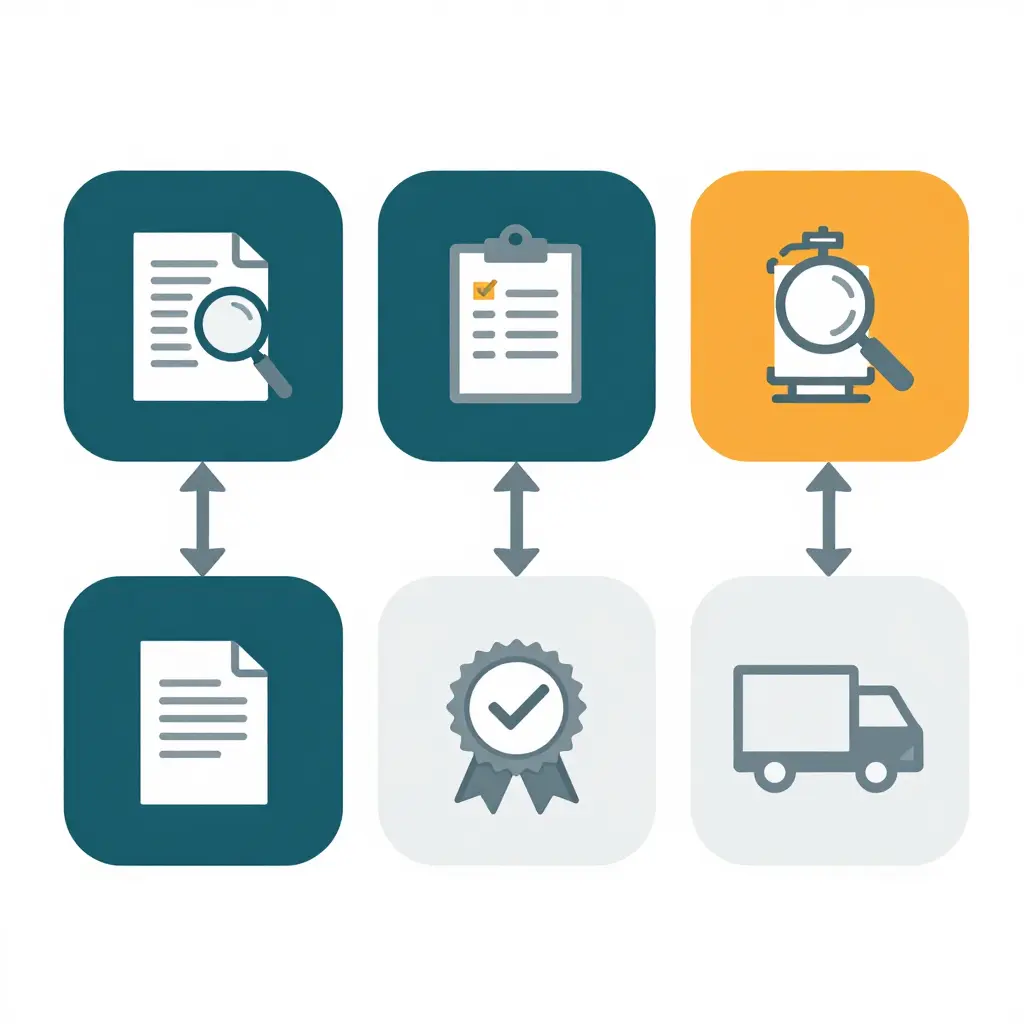
Structuring Procurement for Septic Tank Delivery Trucks in Wholesale Lots
Wholesale purchases break down at the pickup gate when documentation is treated as an afterthought instead of a contractual deliverable. Fleet managers who build paperwork obligations into the deal itself never face the gap between a cleared payment and a truck that legally cannot move.
Supplier Selection Criteria
Screen wholesale truck dealers on documentation capability before you negotiate on price or volume. A vendor who cannot produce certificates on time will stall the whole lot, however good the units are. Ask each supplier to answer for:
- Proven certification throughput – request the average certification turnaround on prior fleet orders, not single-unit sales.
- In-house QC records – tank pressure-test logs, baffle ratings, and vacuum pump specification sheets.
- VIN-to-documentation matching – written confirmation that certificates are issued per VIN, not per batch.
- Reference fleet buyers – at least two B2B customers who accepted delivery of five or more units.
- After-sale documentation support – a stated process for re-issuing lost, delayed, or corrected papers.
- Destination-market readiness – evidence of compliance with registration and inspection rules in your operating region.
Buyers benchmarking entry pricing should review low price septic tank trucks for sale with caution: the cheapest lot frequently carries the weakest documentation trail.
Contract Clauses That Tie Payment to Documentation
Structure payment in tranches keyed to documents, not just physical handover. A deposit should reserve production capacity; a second instalment should trigger only on completion of testing; and the final balance should release only against delivery of the complete documentation package. Define “complete package” explicitly in the contract, listing every certificate, test report, and conformity document required for your jurisdiction.
Lead-Time Planning Around Certification Cycles
Work backward from your target road date and add a buffer for certification turnaround that reflects real-world, not ideal, processing times. If a lot of twenty units requires staggered certification, plan pickup in waves rather than a single handover date. For cross-border volume, align tank and documentation specifications early using China truck water tanks wholesale guidance, since specification mismatches are a leading cause of late papers.
Negotiating Documentation Responsibility
Assign ownership in writing before signing. Confirm who bears the cost and liability if certificates are delayed or rejected, and insist on a defined remedy, such as a per-day credit or a hold on final payment. Sellers who accept these terms are usually the ones whose lots move on schedule.
Reading the Chart: The Paper Trail Outweighs the Iron
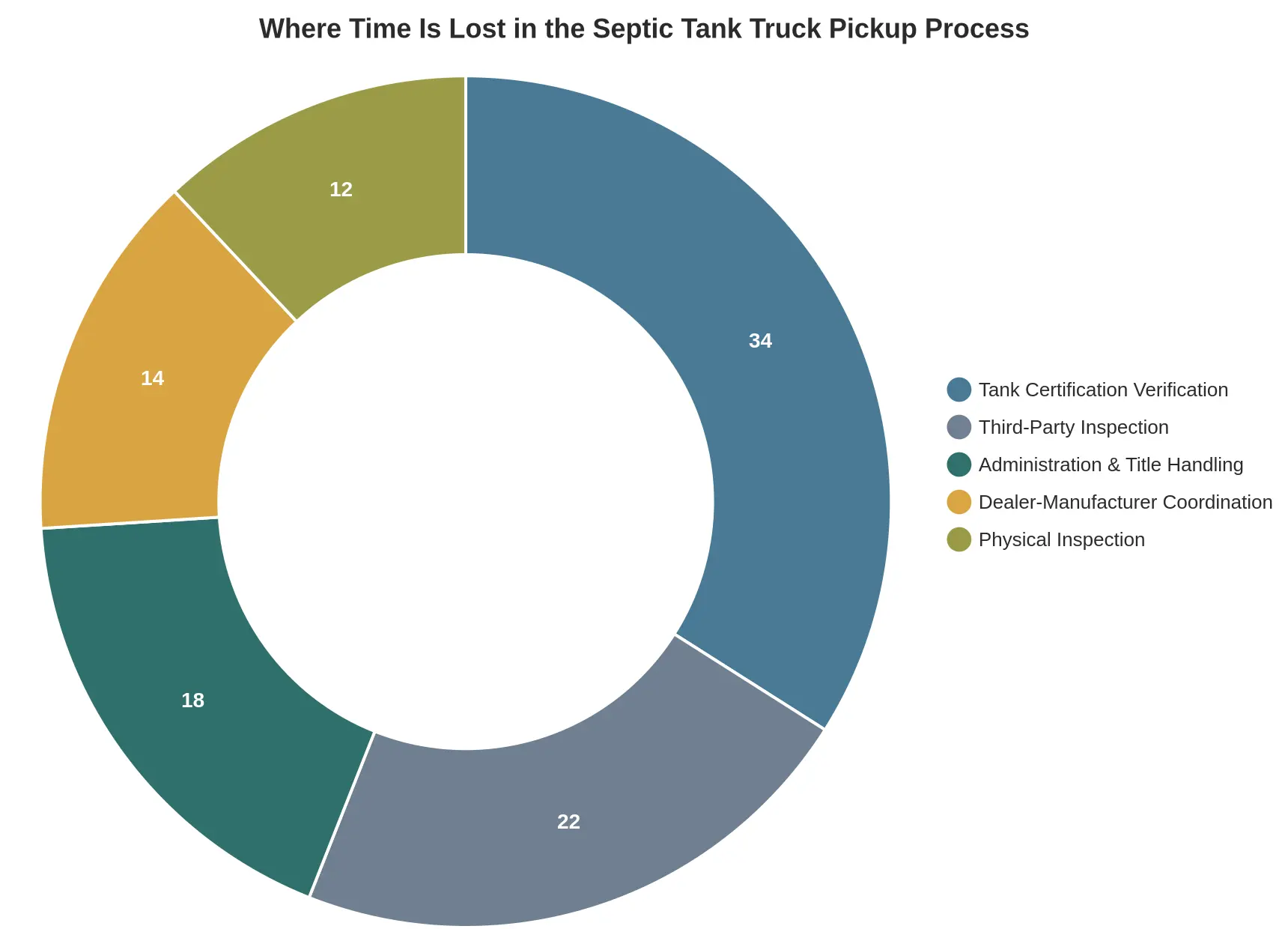
The doughnut above divides total pickup-process time into five stages. Tank certification verification is the largest single sink at 34%, and third-party inspection follows at 22% – together, more than half the timeline is gone before a truck changes hands. Both depend on documents and inspectors outside the dealer’s direct control: a missing or mismatched tank certification triggers a re-verification loop, and third-party inspection schedules are gated by external availability. Administration and title handling adds a steady 18% through lien checks and title transfers, and dealer-manufacturer coordination costs 14% whenever a spec mismatch forces a return to the factory. Physical inspection, the step buyers worry about most, accounts for just 12%, so the truck itself is rarely the bottleneck. Front-load the certification documents and pre-book third-party inspectors before committing to a lot, so your time goes into closing deals instead of chasing forms. For teams weighing the total outlay, these time costs matter as much as the sticker price of a septic tank delivery truck.
Preventive SOP: Eliminating Certification Paperwork Stalls at Pickup
Certification paperwork stalls at pickup are a process defect, not bad luck. Assemble documents reactively on the lot and every missing seal, mismatched specification, or unsigned inspection form becomes an idle loading bay, wasted driver hours, and a disputed handover. This preventive standard operating procedure (SOP) front-loads the work so that septic tank delivery truck documentation is complete, cross-checked, and audit-ready before a unit reaches dispatch.
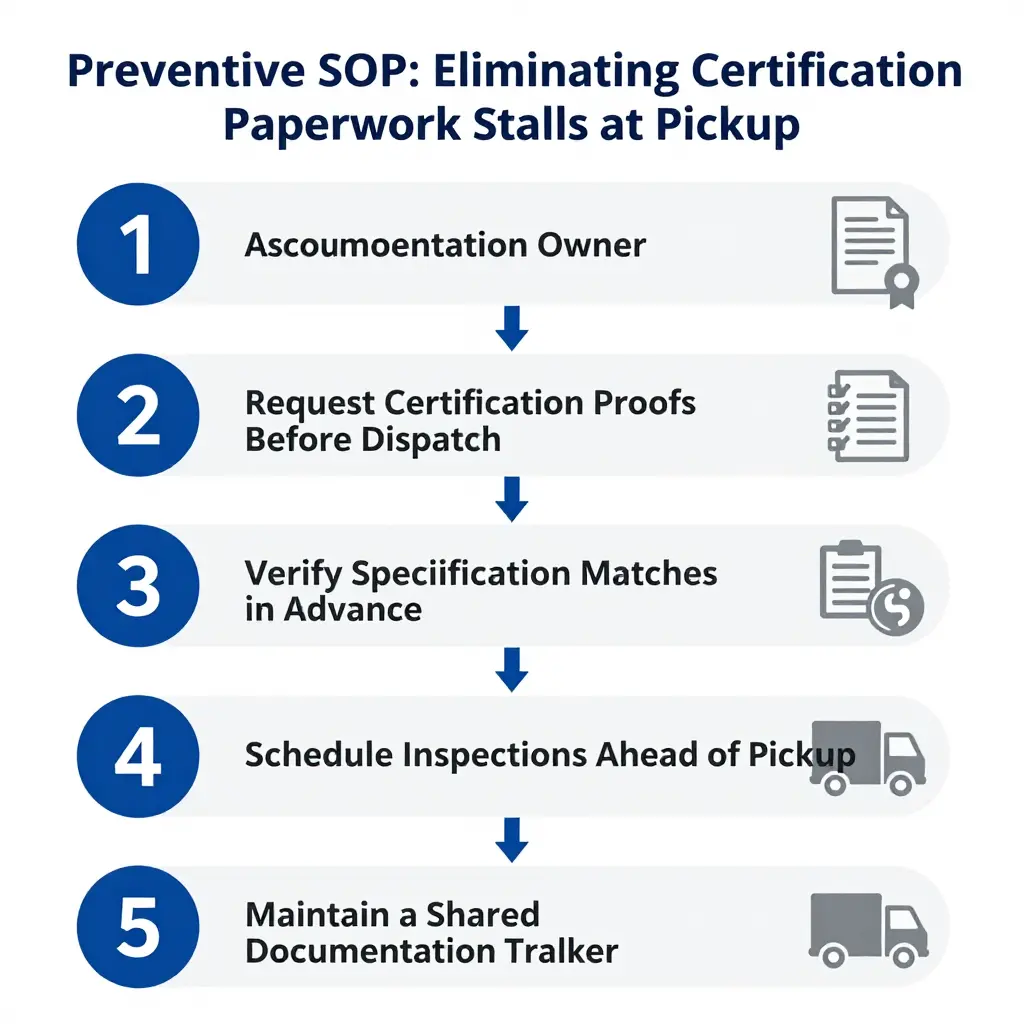
The SOP runs as a fixed five-step sequence. Each step is owned, time-boxed, and verifiable before the next one begins.
-
Assign a documentation owner. Designate one accountable individual – never a committee – as the documentation owner for each wholesale lot. This person maintains the master file, tracks every certificate of conformity, and serves as the single point of contact for the dealer, the OEM, and the transport carrier. Single-point ownership eliminates the “I assumed someone else had it” gap that triggers most pickup stalls.
-
Request certification proofs before dispatch. The owner formally requests all certification paperwork from the supplier well ahead of the transport date – tank pressure-test certificates, vacuum pump conformity declarations, baffle ratings, VIN and axle-weight records, emissions, and DOT documentation. Require digital PDF copies at least three business days in advance so discrepancies surface at a desk, not at a gate.
-
Verify specification matches in advance. Compare certificate data against the purchase order line by line: tank volume, vacuum pump type, baffle rating, and material grade. Resolve every mismatch before the truck moves. Specification drift carries hidden cost as well, since tank size and vacuum pump configuration directly shape unit economics, so review how tank size and vacuum pump type split the price before you sign off. Catching a mismatch at the desk is cheaper than catching it at the gate.
-
Schedule inspections ahead of pickup. Book third-party or state inspections into the calendar before the pickup window opens, and confirm inspector availability in writing. Pre-scheduling converts inspection from a pickup-day blocker into a completed prerequisite, so compliance sign-off never competes with loading logistics.
-
Maintain a shared documentation tracker. Run one live tracker listing each unit’s required documents, status, owner, and expiry date. Visible status lets procurement, transport, and compliance work from the same truth and escalate gaps early.
Review the tracker weekly: any unit flagged incomplete escalates to the documentation owner. Run this consistently and certification stops being a reactive bottleneck; it becomes a controlled, auditable pre-dispatch checklist, and pickup stalls stay out of the operation.
FAQ: Certification Paperwork and Pickup for Wholesale Septic Tank Trucks
Certification is where an otherwise smooth wholesale deal can slow to a crawl. The answers below cover the documents that should travel with the truck, realistic timelines, mismatches between paperwork and the physical unit, and what to do when something turns up missing after the sale.
What certification documents must accompany a septic tank delivery truck at pickup?
At minimum, the truck should leave the lot with a certificate of origin or title, a compliance or emissions certificate where the jurisdiction requires one, the tank pressure-test or vacuum-integrity report, and a build or specification sheet listing tank capacity, baffle ratings, and pump details. For imported units, customs clearance and a conformity certificate are also standard. Verify that the VIN on every document matches the VIN plate on the chassis. When sourcing septic tank delivery trucks in wholesale lots, insist on a single document checklist signed off before the truck rolls.
How long does tank certification paperwork typically take?
Turnaround depends on the certification scope and the jurisdiction. In-house tank pressure and integrity testing usually completes within one to three business days. Third-party certification, emissions testing, or import conformity review commonly takes five to ten business days. Registrations or permits tied to a specific state or province can add another week. Plan on two to three weeks from purchase to a fully documented, road-legal truck rather than assuming same-day release.
Why does documentation sometimes not match the delivered truck?
Mismatches happen for several practical reasons. Wholesale lots often hold multiple identical units, and staff may pull a spec sheet from a similar truck. Refits or tank swaps completed after the original certification may never be re-documented. Sometimes a pump or baffle upgrade is installed but the certificate still reflects the factory build. Always reconcile capacity, baffle ratings, pump model, and VIN against the physical asset at the point of inspection, not after transport.
Can pickup proceed if certification is incomplete?
Pickup can sometimes proceed conditionally, but it carries risk. Most reputable dealers will release a truck against a signed conditional-release agreement that commits to supplying missing certificates within a defined window. Releasing a septic tank delivery truck without valid documentation can void warranty coverage, complicate registration, and expose the buyer to liability if the unit is stopped in transit. If the missing item is safety- or compliance-critical, hold the truck until the certificate is in hand.
What happens if certification paperwork is missing after the sale?
Once the sale closes, responsibility shifts to the buyer, which makes recovery harder. The buyer must request duplicate certificates from the manufacturer, tank fabricator, or testing lab, and these can take one to four weeks to reissue. Missing titles or origin documents may require a bonded title process, which varies by state. The clearest protection is a purchase contract that lists every required certificate and withholds final payment until all documents are delivered and verified.
How can buyers reduce pickup delays?
Request a document checklist and digital copies before dispatch, schedule the inspection to coincide with certification completion, and assign one person to verify VIN, capacity, and pump details against the physical truck. Prompt, documented communication with the dealer prevents most avoidable pickup delays and keeps the fleet on schedule.